Menu

SOCIAL NETWORK ANALYSIS

Social Network Visualizations

From network graphs and community detection to centrality metrics and information diffusion cascades - create publication-ready social network figures with AI-generated Python code.

or browse all example datasets

Essential Network Visualizations

Social network data spans relational graphs, temporal interaction logs, influence metrics, and community membership. Each requires specialized layout algorithms and visual encodings to reveal hidden structure in connected data.

Network Graphs

Force-directed and spring layouts revealing cluster structure and bridge nodes

Community Detection

Louvain, modularity-based, and label propagation clustering with colored partitions

Degree Distributions

Log-log histograms with power-law fitting to identify scale-free properties

Centrality Heatmaps

Betweenness, closeness, and eigenvector centrality mapped across the network

Adjacency Matrices

Sorted and clustered matrix views exposing block-diagonal community patterns

Diffusion Cascades

Temporal spread of information, influence, or contagion through network layers

Why Network Scientists Use Plotivy

Graph Analysis

Detect communities, measure clustering coefficients, and compute shortest path lengths - all from a natural language prompt.

Metric Dashboards

Centrality, betweenness, PageRank, and eigenvector scores visualized as node-level heatmaps and ranked bar charts.

Publication Formats

Export to SVG/PDF sized for Social Networks, Network Science, and PNAS column widths with correct DPI and fonts.

Interactive Exploration

Zoom into subgraphs, filter by centrality thresholds, and highlight ego networks with interactive Plotly outputs.

Network Graph with Community Detection

A small-world network of 60 nodes partitioned into four communities. Node size encodes degree centrality and hub nodes are highlighted with rings. Edit the code to adjust edge probabilities or add new communities.

Live Code Editor
Code EditorPython
Loading editor...
Live Preview

Preparing preview

Running once automatically on first load

Learn by Experimenting

This is a safe playground for learning! Try changing:

  • • Colors: Modify color values to see different palettes
  • • Numbers: Adjust sizes, positions, or data ranges
  • • Labels: Update titles, axis names, or legends

Edit the code, run it, then open the full data visualization tool to continue with your own dataset.

Degree Distribution with Power Law Fit

Log-log degree histogram of a scale-free network with fitted power law exponent. The complementary CDF panel confirms the heavy-tailed distribution characteristic of real social networks.

Live Code Editor
Code EditorPython
Loading editor...
Live Preview

Preparing preview

Running once automatically on first load

Learn by Experimenting

This is a safe playground for learning! Try changing:

  • • Colors: Modify color values to see different palettes
  • • Numbers: Adjust sizes, positions, or data ranges
  • • Labels: Update titles, axis names, or legends

Edit the code, run it, then open the full data visualization tool to continue with your own dataset.

Chart gallery

Explore Network Chart Types

Interactive examples with ready-to-run code

Browse all chart types →
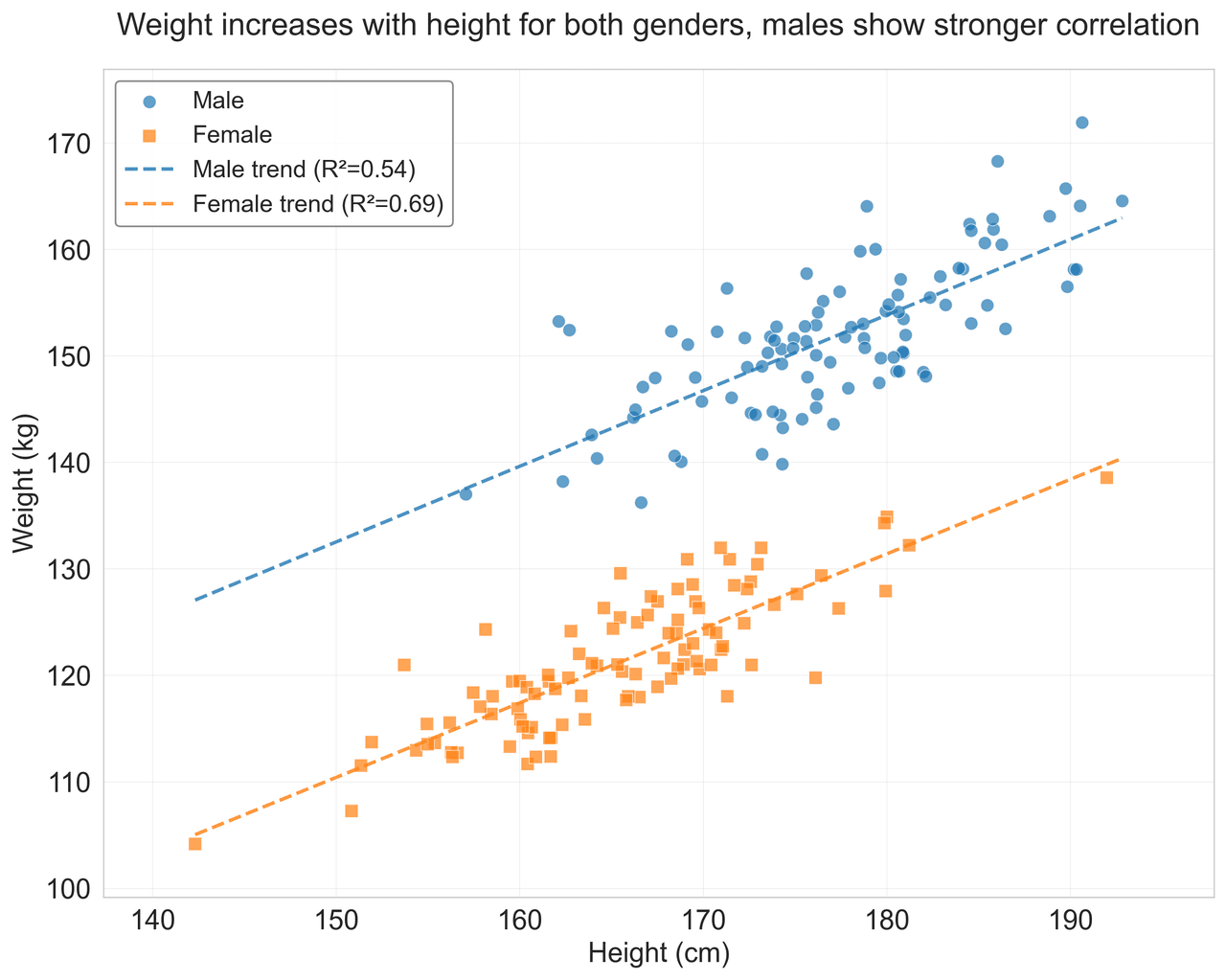
Scatter plot of height vs weight colored by gender with regression line
Statistical•matplotlib, seaborn
From the chart gallery•Correlation analysis between metrics

Scatterplot

Displays values for two variables as points on a Cartesian coordinate system.

Sample code / prompt

import matplotlib.pyplot as plt
import numpy as np
from scipy import stats
import pandas as pd

# Generate sample data
np.random.seed(42)
n_samples = 200
height = np.random.normal(170, 8, n_samples)
weight = height * 0.6 + np.random.normal(0, 8, n_samples) - 50
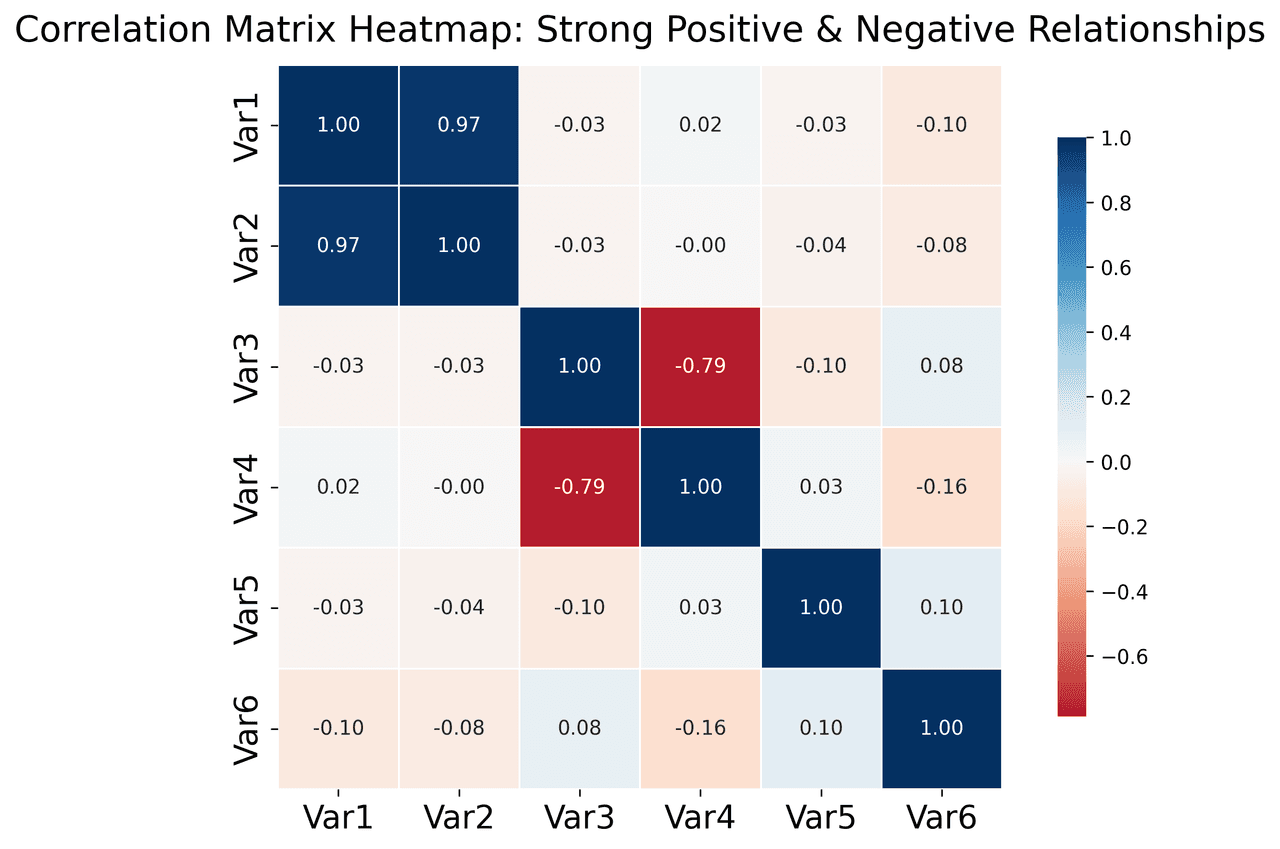
Correlation heatmap with diverging color scale and coefficient annotations
Statistical•seaborn, matplotlib
From the chart gallery•Correlation analysis between variables

Heatmap

Represents data values as colors in a two-dimensional matrix format.

Sample code / prompt

import matplotlib.pyplot as plt
import seaborn as sns
import pandas as pd
import numpy as np

# Create correlation matrix for financial metrics
metrics = ['Revenue', 'Profit', 'Expenses', 'ROI', 'Customers', 'AOV', 'Marketing', 'Employees']
correlation_data = np.array([
    [1.00, 0.85, -0.45, 0.72, 0.88, 0.65, 0.72, 0.55],
    [0.85, 1.00, -0.78, 0.92, 0.75, 0.58, 0.63, 0.48],
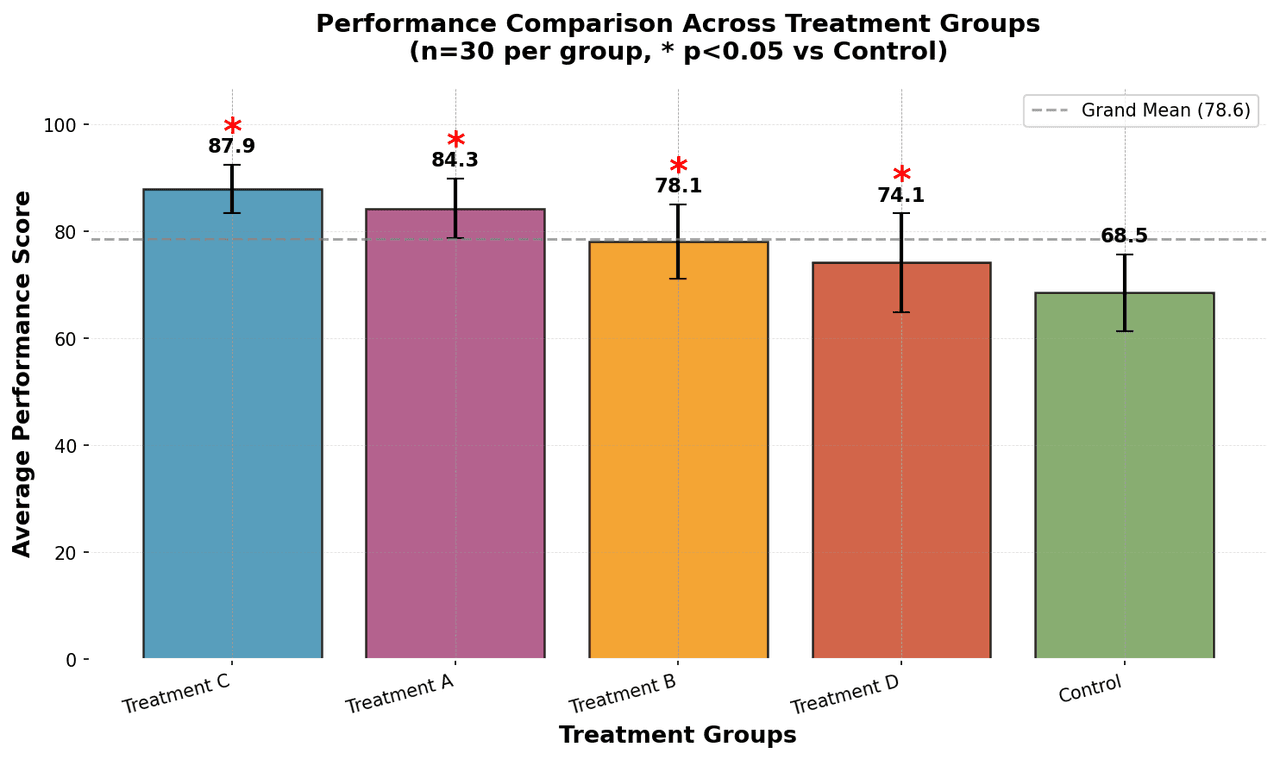
Bar chart comparing average scores across 5 groups with error bars
Comparison•matplotlib, seaborn
From the chart gallery•Comparing performance across categories

Bar Chart

Compares categorical data using rectangular bars with heights proportional to values.

Sample code / prompt

import numpy as np
import pandas as pd
import matplotlib.pyplot as plt
import seaborn as sns
from scipy import stats

# Generate performance scores for 5 treatment groups
np.random.seed(42)
groups = ['Control', 'Treatment A', 'Treatment B', 'Treatment C', 'Treatment D']
n_samples = 30
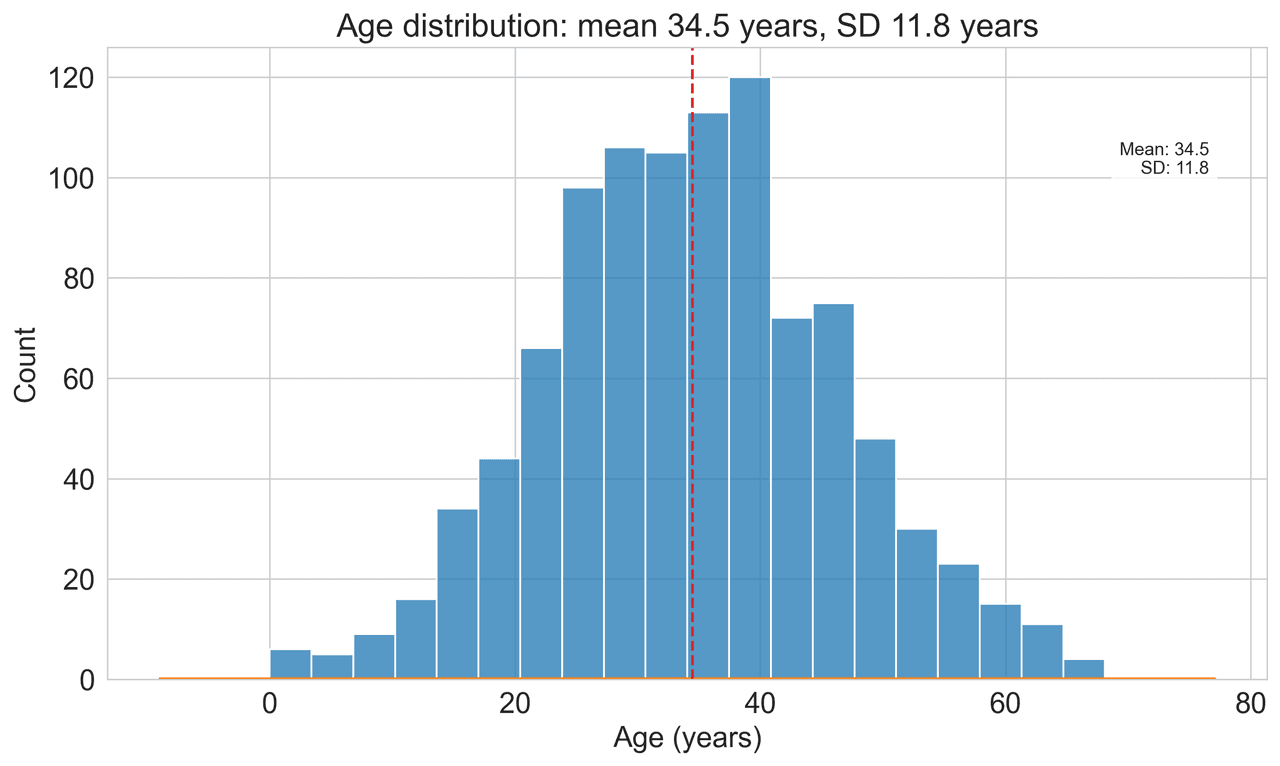
Histogram showing age distribution with 20 bins and KDE overlay
Distribution•matplotlib, seaborn
From the chart gallery•Analyzing age demographics

Histogram

Displays the distribution of numerical data by grouping values into bins.

Sample code / prompt

import matplotlib.pyplot as plt
import numpy as np
from scipy.stats import gaussian_kde, skewnorm

# Generate age data with slight right skew
np.random.seed(42)
ages = skewnorm.rvs(a=2, loc=42, scale=15, size=500)
ages = np.clip(ages, 18, 80)  # Clip to realistic range

fig, ax = plt.subplots(figsize=(12, 7))
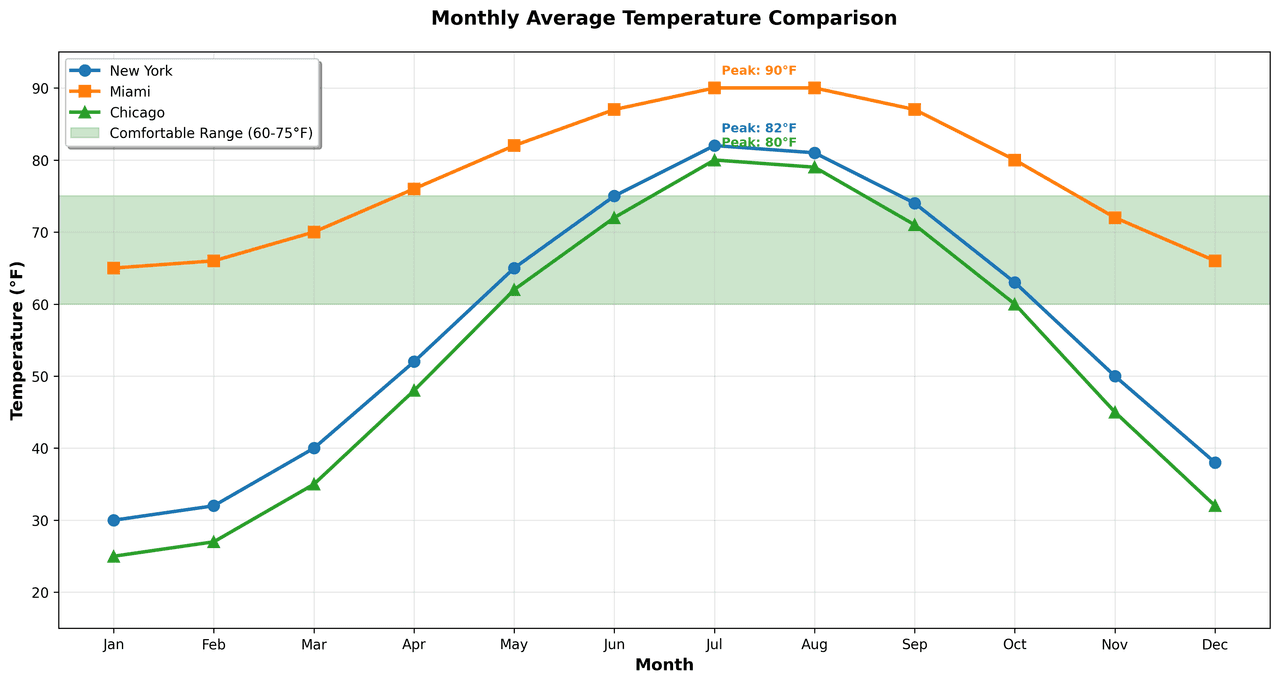
Multi-line graph showing temperature trends for 3 cities over a year
Time Series•matplotlib, seaborn
From the chart gallery•Stock price tracking over time

Line Graph

Displays data points connected by straight line segments to show trends over time.

Sample code / prompt

import matplotlib.pyplot as plt
import numpy as np

# Generate temperature data for 3 major US cities over 12 months
months = ['Jan', 'Feb', 'Mar', 'Apr', 'May', 'Jun', 'Jul', 'Aug', 'Sep', 'Oct', 'Nov', 'Dec']
nyc = [30, 32, 40, 52, 65, 75, 82, 81, 74, 63, 50, 38]
miami = [65, 66, 70, 76, 82, 87, 90, 90, 87, 80, 72, 66]
chicago = [25, 27, 35, 48, 62, 72, 80, 79, 71, 60, 45, 32]

# Create figure with enhanced styling

Ready to Visualize Your Network Data?

Upload your edge list or adjacency data, describe the plot you need, and get publication-ready network figures with full Python code in seconds.

Start Free - No Sign-Up