How do I create a publication-ready table in Python?
Upload your data to Plotivy, open the Summary Statistics Table tool, choose the columns and statistics you need, then export. Plotivy generates runnable matplotlib code that renders a styled table figure at 300 DPI - with a shaded header, alternating row colors, and a bold index column - ready to drop into a paper or slide deck.
Can I export tables to LaTeX?
Yes. Every summary table can be copied as LaTeX in the journal-standard booktabs style (toprule, midrule, bottomrule) or as a classic ruled grid. The output includes a caption and label so you can reference it with \ref{} immediately. You only need \usepackage{booktabs} in your preamble.
What is the booktabs style and why use it?
Booktabs is the de-facto standard for professional LaTeX tables. It uses three horizontal rules (top, middle, bottom) and avoids vertical lines, producing the clean, uncluttered look you see in Nature, Science, and most peer-reviewed journals. Plotivy uses booktabs by default.
Which export formats are supported?
Plotivy exports summary tables as LaTeX (booktabs or grid), runnable Python (matplotlib), Word (RTF), Markdown, HTML, and CSV. Copy any format to the clipboard in one click, or download the Word and CSV files directly.
Can I export tables to Microsoft Word?
Yes. Download the table as an RTF file and open it in Microsoft Word (or LibreOffice/Pages) - it imports as a real, editable table with a bold header row, not a flat image. This works without installing anything and keeps your formatting intact.
Can Plotivy make a Table 1 with p-values?
Yes. Turn on comparison mode and pick a grouping column to get the classic 'Table 1' layout: variables as rows, groups as columns with their sample sizes, cells as Mean ± SD or Median [IQR], and a p-value column. Plotivy chooses the test automatically - Welch's t-test or one-way ANOVA when the groups look normal, Mann-Whitney U or Kruskal-Wallis otherwise - or you can force a parametric or non-parametric test. The test used is recorded in the table caption.
Can I make color-graded or conditionally formatted tables?
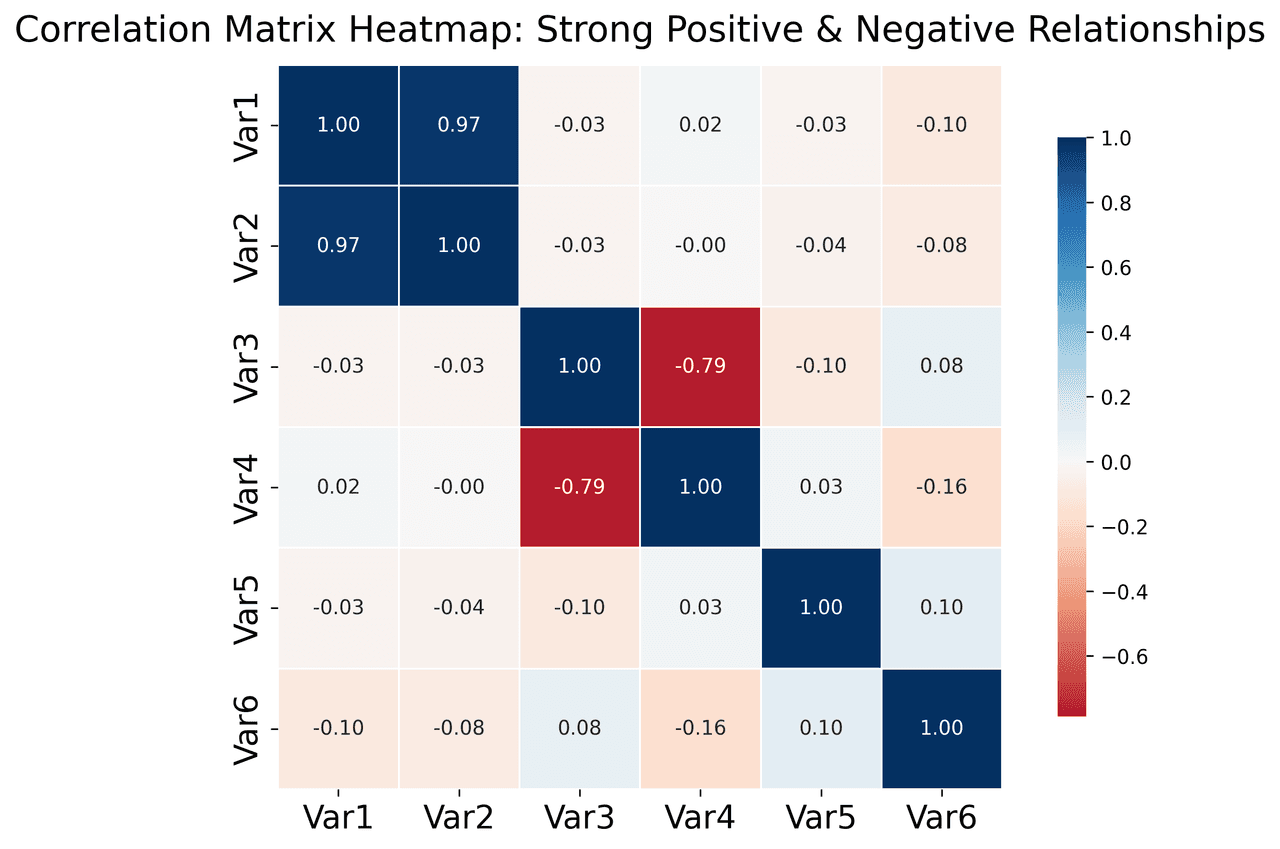
Yes. Using the matplotlib export you can shade each cell by its value - ideal for correlation matrices, heatmap tables, and scorecards. The live editor on this page includes a ready-to-edit color-graded table example.
Do I need to know Python or LaTeX to use it?
No. You can generate and export tables entirely through the point-and-click interface. The Python and LaTeX code is provided so you can reproduce, version-control, or fine-tune the output if you want to - but it is optional.
.png&w=1280&q=70)