Menu

Distribution Diagnostics

QQ Plot Generator in Python for Normality Checks and Residual Diagnostics

QQ plots are the quickest way to compare sample quantiles against a theoretical distribution. Use them to inspect normality, validate model residuals, and reveal skew or heavy tails before you overfit the next analysis.

When to Use a QQ Plot

A QQ plot is a diagnostic figure, not just a statistical ornament. It shows whether your data actually follow the assumptions behind a t-test, linear model, or other parametric method. If the points bend away from the reference line, your data are telling you something useful about skew, outliers, or non-normal tails.

Normality checks

Verify whether a sample looks reasonably Gaussian before using parametric tests.

Residual diagnostics

Inspect model errors after regression, ANOVA, or curve fitting.

Tail behavior

Spot heavy tails, skew, or truncation that a histogram can hide.

Distribution comparison

Compare transformed data against the target theoretical distribution.

Fast assumption checks

Turn one visual into a clear decision point before moving to inferential statistics.

Publication-friendly formatting

Use a clean reference line, legible axes, and a minimal layout that reads well in a methods section.

Distribution insight

Make it obvious when data need transformation, trimming, or a non-parametric approach.

Editable Python code

Keep the exact diagnostic logic transparent for review, collaboration, and reruns.

Live Code Lab: QQ Plot

This example uses a slightly skewed sample so the departure from the reference line is easy to see. Replace the values with your own residuals or measurement series to validate a real model.

Live Code Editor
Code EditorPython
Loading editor...
Live Preview

Preparing preview

Running once automatically on first load

Learn by Experimenting

This is a safe playground for learning! Try changing:

  • • Colors: Modify color values to see different palettes
  • • Numbers: Adjust sizes, positions, or data ranges
  • • Labels: Update titles, axis names, or legends

Edit the code, run it, then open the full data visualization tool to continue with your own dataset.

Chart gallery

Related Chart Types

Diagnostic and summary charts that help with distribution analysis

Browse all chart types →
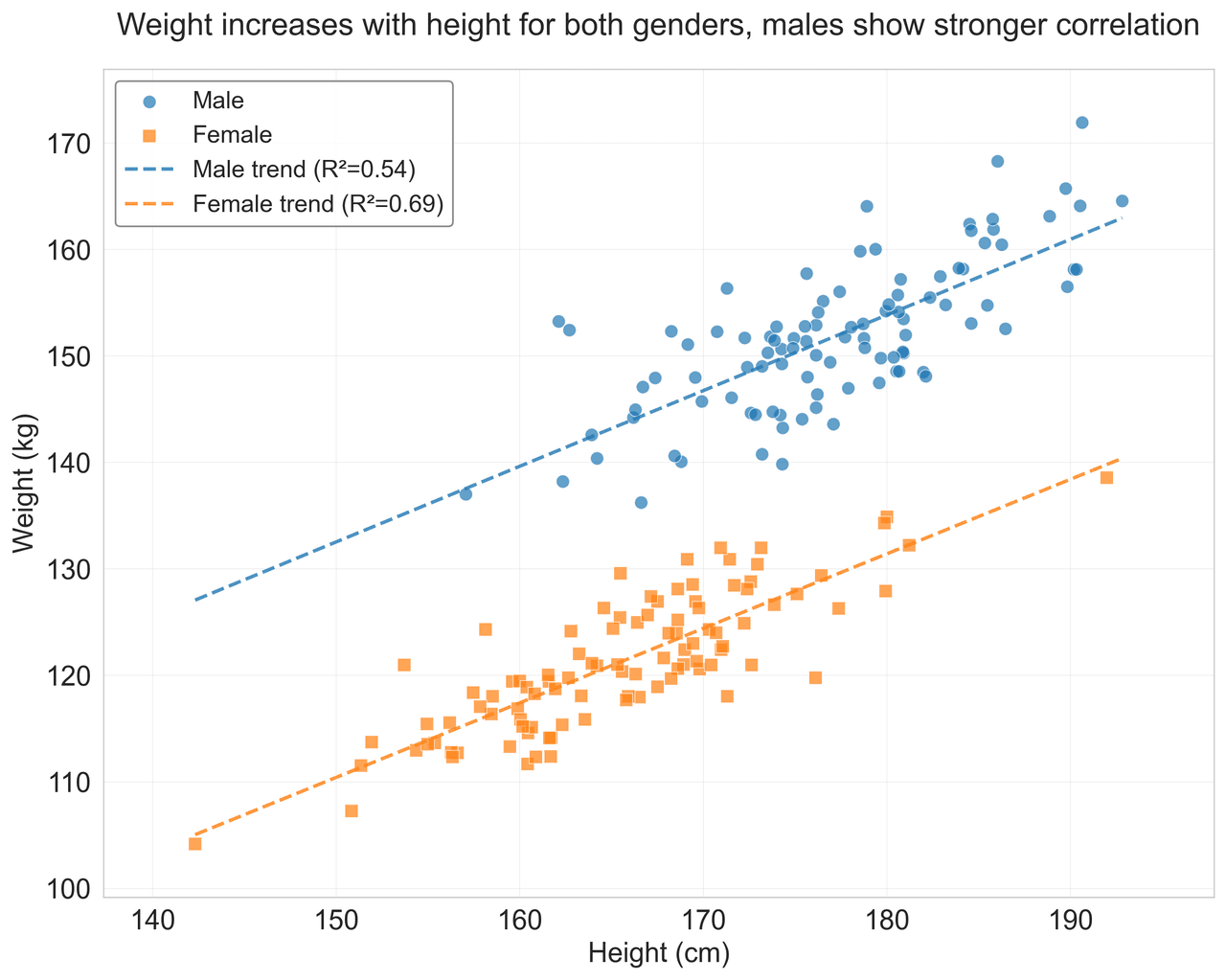
Scatter plot of height vs weight colored by gender with regression line
Statistical•matplotlib, seaborn
From the chart gallery•Correlation analysis between metrics

Scatterplot

Displays values for two variables as points on a Cartesian coordinate system.

Sample code / prompt

import matplotlib.pyplot as plt
import numpy as np
from scipy import stats
import pandas as pd

# Generate sample data
np.random.seed(42)
n_samples = 200
height = np.random.normal(170, 8, n_samples)
weight = height * 0.6 + np.random.normal(0, 8, n_samples) - 50
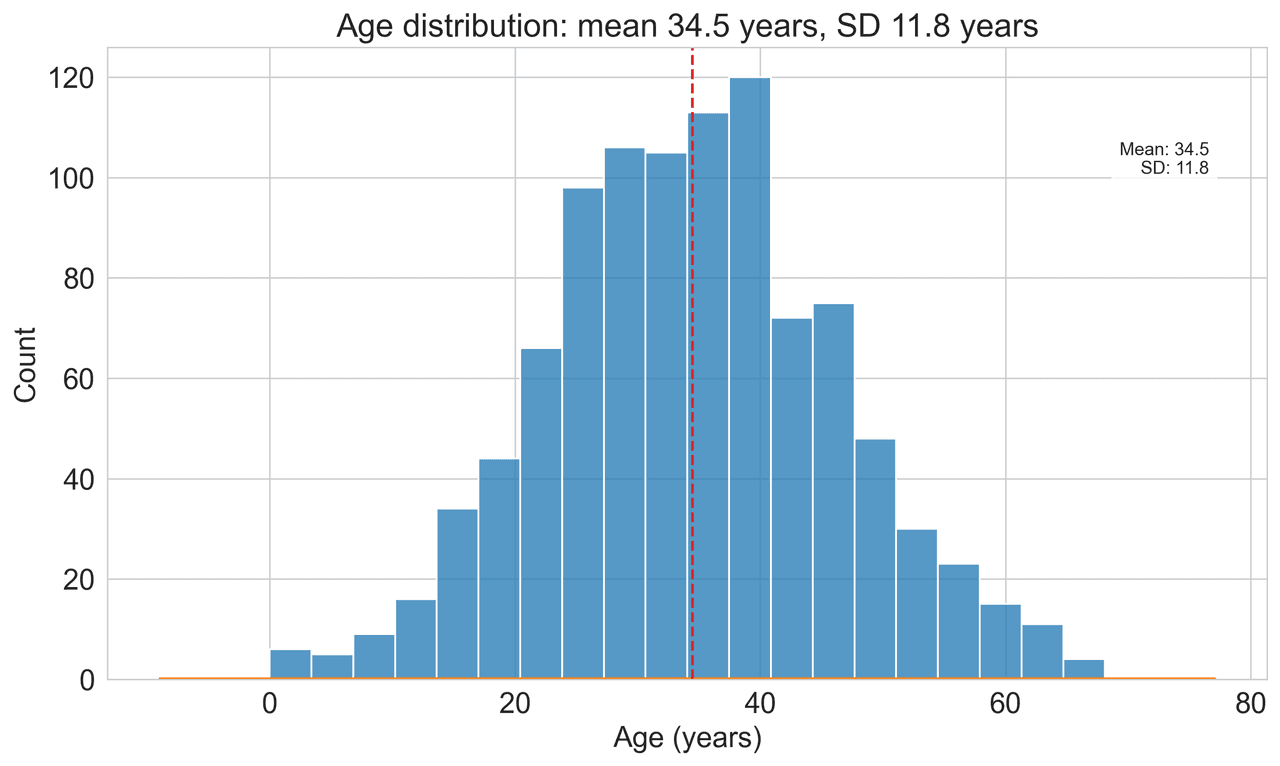
Histogram showing age distribution with 20 bins and KDE overlay
Distribution•matplotlib, seaborn
From the chart gallery•Analyzing age demographics

Histogram

Displays the distribution of numerical data by grouping values into bins.

Sample code / prompt

import matplotlib.pyplot as plt
import numpy as np
from scipy.stats import gaussian_kde, skewnorm

# Generate age data with slight right skew
np.random.seed(42)
ages = skewnorm.rvs(a=2, loc=42, scale=15, size=500)
ages = np.clip(ages, 18, 80)  # Clip to realistic range

fig, ax = plt.subplots(figsize=(12, 7))
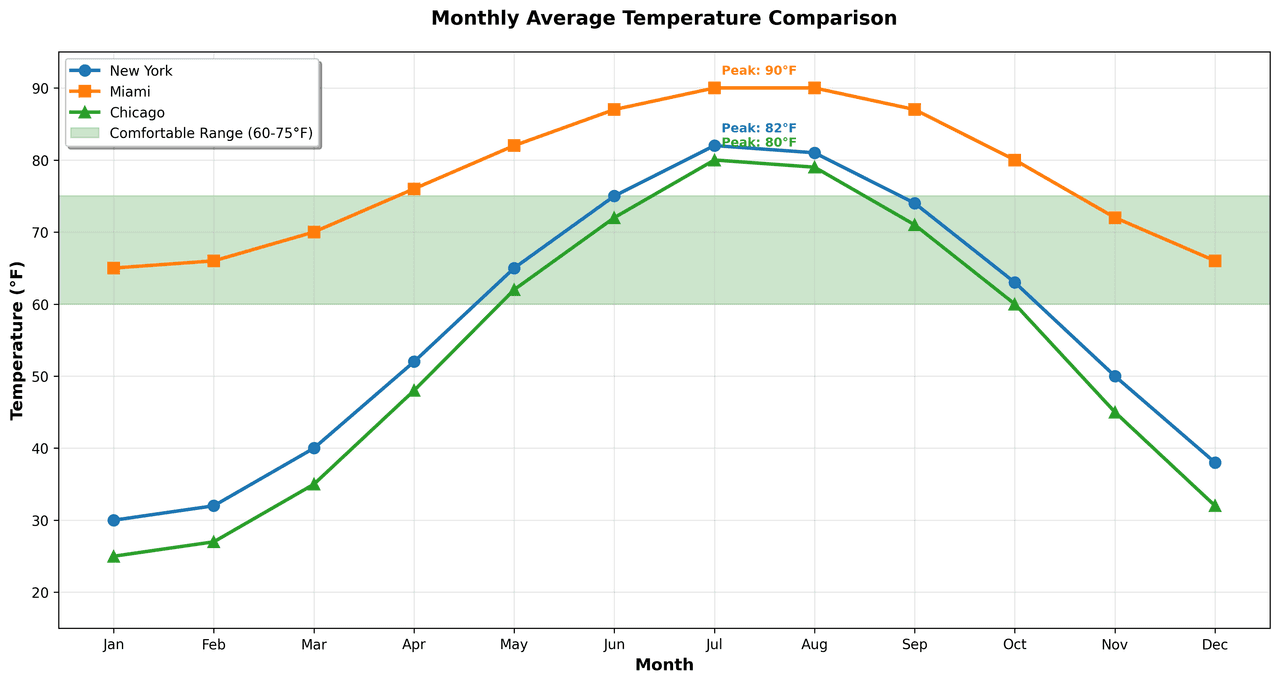
Multi-line graph showing temperature trends for 3 cities over a year
Time Series•matplotlib, seaborn
From the chart gallery•Stock price tracking over time

Line Graph

Displays data points connected by straight line segments to show trends over time.

Sample code / prompt

import matplotlib.pyplot as plt
import numpy as np

# Generate temperature data for 3 major US cities over 12 months
months = ['Jan', 'Feb', 'Mar', 'Apr', 'May', 'Jun', 'Jul', 'Aug', 'Sep', 'Oct', 'Nov', 'Dec']
nyc = [30, 32, 40, 52, 65, 75, 82, 81, 74, 63, 50, 38]
miami = [65, 66, 70, 76, 82, 87, 90, 90, 87, 80, 72, 66]
chicago = [25, 27, 35, 48, 62, 72, 80, 79, 71, 60, 45, 32]

# Create figure with enhanced styling
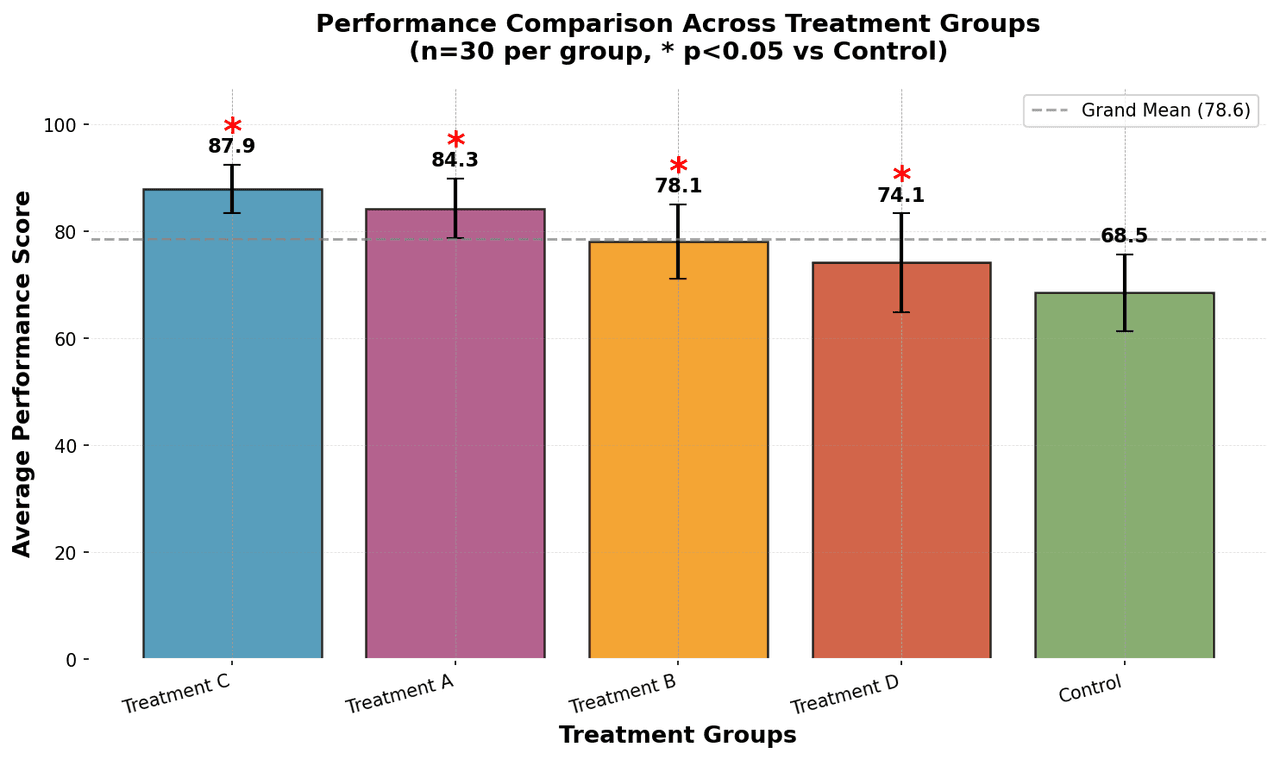
Bar chart comparing average scores across 5 groups with error bars
Comparison•matplotlib, seaborn
From the chart gallery•Comparing performance across categories

Bar Chart

Compares categorical data using rectangular bars with heights proportional to values.

Sample code / prompt

import numpy as np
import pandas as pd
import matplotlib.pyplot as plt
import seaborn as sns
from scipy import stats

# Generate performance scores for 5 treatment groups
np.random.seed(42)
groups = ['Control', 'Treatment A', 'Treatment B', 'Treatment C', 'Treatment D']
n_samples = 30
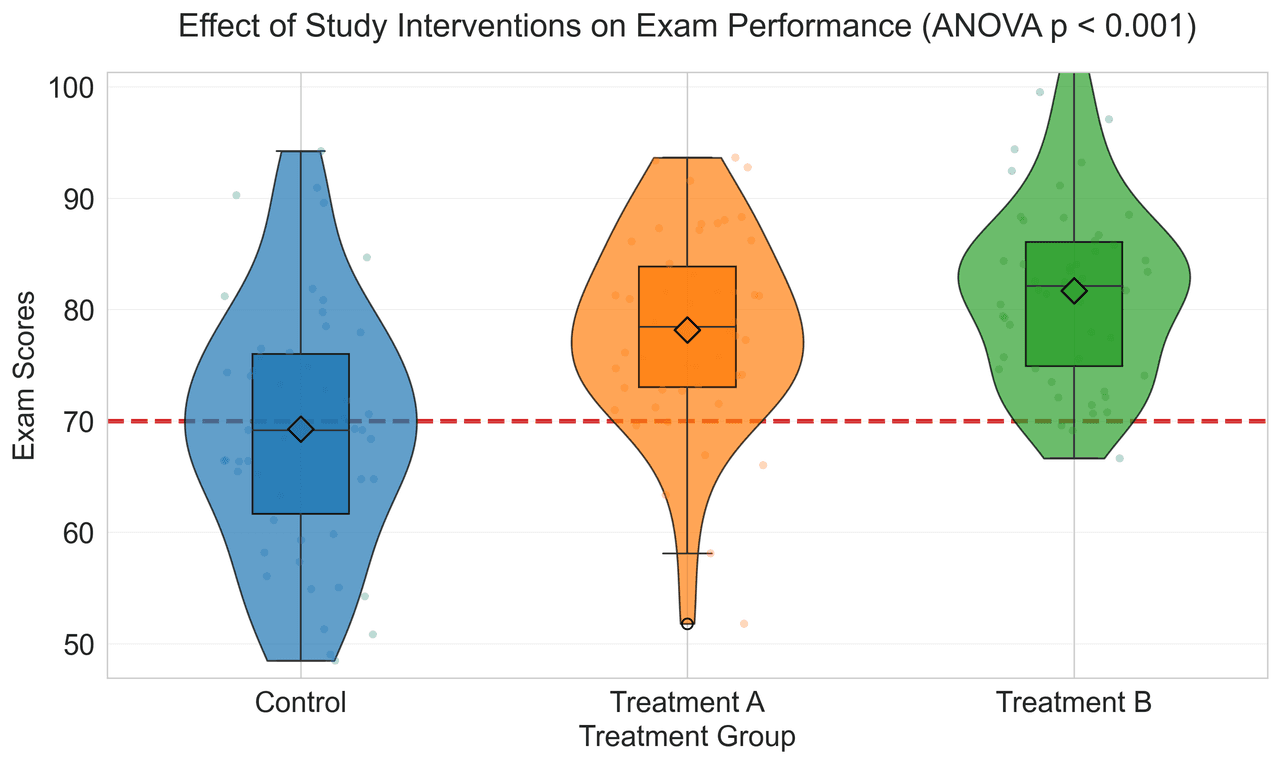
Violin plot comparing score distributions across 3 groups with inner box plots
Distribution•seaborn, matplotlib
From the chart gallery•Comparing treatment effects across groups

Violin Plot

Combines box plots with kernel density to show distribution shape across groups.

Sample code / prompt

import matplotlib.pyplot as plt
import seaborn as sns
import pandas as pd
import numpy as np
from scipy.stats import f_oneway

# Generate exam score data for 3 groups
np.random.seed(42)
control = np.random.normal(72, 12, 50)
treatment_a = np.random.normal(78, 10, 50)

Check Assumptions Before They Break a Model

Use a QQ plot to decide whether your data are close enough to normal, whether a transform is needed, or whether a different analysis path makes more sense.