Arrhenius Plot
Chart overview
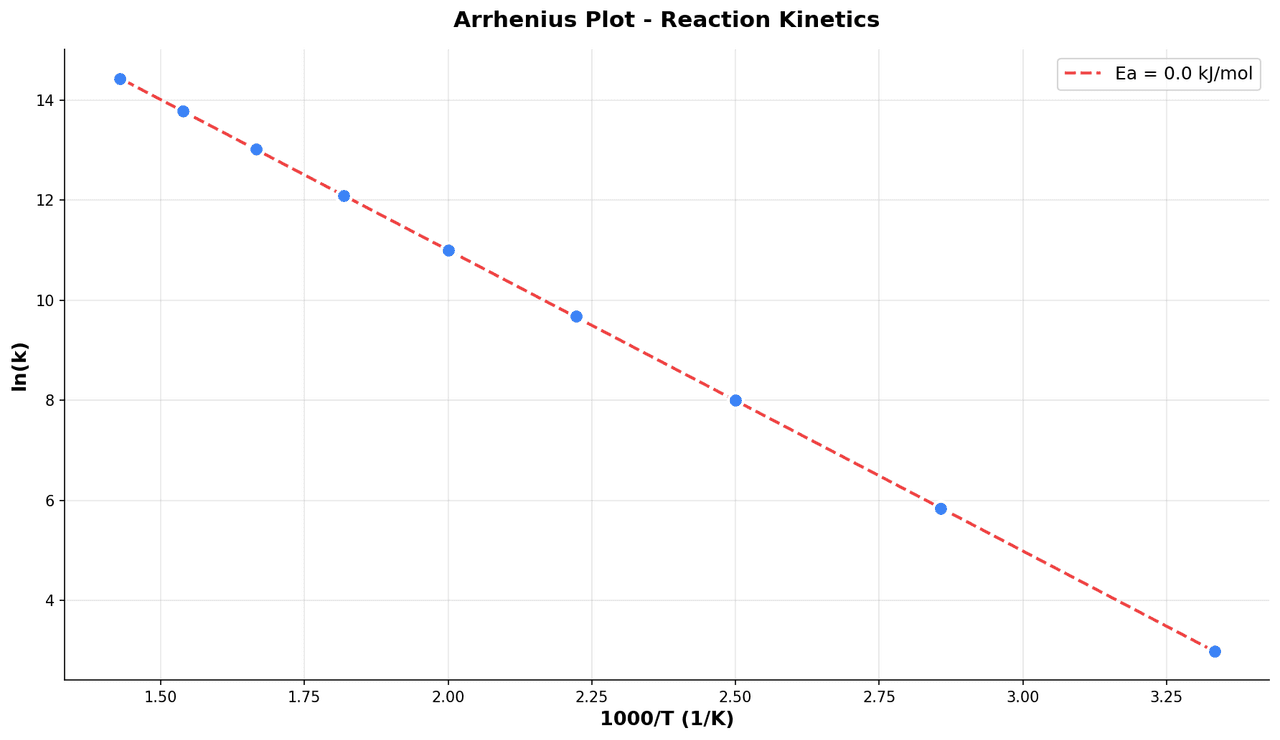
The Arrhenius plot is the standard graphical technique for determining activation energies of thermally activated processes, from chemical reaction kinetics to solid-state diffusion, creep, and dielectric relaxation.
Key points
- By linearizing the Arrhenius equation as ln(k) = ln(A) - Ea/(RT), a straight line fit yields the activation energy Ea from the slope and the pre-exponential factor A from the intercept.
- This analysis is ubiquitous in heterogeneous catalysis, battery electrode kinetics, semiconductor dopant diffusion, and protein denaturation studies.
Create a Arrhenius Plot with your data using AI — no coding required.
Further reading
Python Scatter Plot Tutorial
Build scatter plots with regression overlays, color encodings, and uncertainty bars.
Read the guideExample Visualization
Create This Chart Now
Generate publication-ready arrhenius plots with AI in seconds. No coding required – just describe your data and let AI do the work.
View example prompt
"Create a publication-quality Arrhenius plot from my kinetics data. Plot ln(k) or log(k) on the y-axis versus 1/T (K^-1) on the x-axis. Perform a linear regression and overlay the fit line. Calculate and annotate the activation energy Ea = -slope * R with its uncertainty, and the pre-exponential factor A from the intercept. Add axis labels 'ln(k)' (or 'log(k)') and '1/T (K^-1)', a legend with the fitted Ea value, and a descriptive title. Use data point markers with error bars if uncertainty data is available. White background, professional styling."
How to create this chart with your data
Upload Data
Upload your Excel or CSV file. Data used to generate charts is sent to Plotivy's server for processing.
AI Generation
Our AI analyzes your data and generates the Arrhenius Plot code automatically.
Customize & Export
Tweak the design with natural language, then export as high-res PNG, SVG or PDF.
Newsletter
Get one weekly tip for better arrhenius plots
Join researchers receiving concise Python plotting techniques to improve chart clarity and reduce revision cycles.
Python Code Example
Console Output
Figure saved: plotivy-arrhenius-plot.png
Common Use Cases
- 1Determining activation barriers for heterogeneous catalytic reactions
- 2Measuring dopant diffusion activation energies in semiconductor processing
- 3Characterizing creep mechanisms and diffusion-controlled deformation in alloys
- 4Modeling lithium-ion battery charge transfer kinetics over temperature ranges
Pro Tips
Plot 1/T on the x-axis in units of 10^-3 K^-1 to avoid very small numbers
Include error bars on data points and report the 95% confidence interval on Ea
Check for curvature indicating a non-Arrhenius mechanism or multiple regimes
Annotate the slope value and convert to Ea in kJ/mol or eV using R = 8.314 J/mol/K
Frequently asked questions
When should you use an arrhenius plot?
The Arrhenius plot is the standard graphical technique for determining activation energies of thermally activated processes, from chemical reaction kinetics to solid-state diffusion, creep, and dielectric relaxation. By linearizing the Arrhenius equation as ln(k) = ln(A) - Ea/(RT), a straight line fit yields the activation energy Ea from the slope and the pre-exponential factor A from the intercept. Common applications include determining activation barriers for heterogeneous catalytic reactions, measuring dopant diffusion activation energies in semiconductor processing, and characterizing creep mechanisms and diffusion-controlled deformation in alloys.
Which Python libraries can create an arrhenius plot?
An arrhenius plot can be built in Python with matplotlib and numpy — matplotlib for precise control over axes, annotations, and journal styling and numpy. In Plotivy you describe the figure and it writes the matplotlib code for you.
Can I make an arrhenius plot without writing Python code?
Yes. Describe the arrhenius plot you need in plain language and upload your dataset — Plotivy's AI writes the Python code and renders a publication-ready figure. You still get the full, editable matplotlib source, so nothing is locked in a black box.
What are best practices for a clear arrhenius plot?
Plot 1/T on the x-axis in units of 10^-3 K^-1 to avoid very small numbers. Include error bars on data points and report the 95% confidence interval on Ea.
Library comparison for this chart
matplotlib
Best when you need full control over axis formatting, annotation placement, and journal-specific styling for arrhenius-plot.
numpy
Useful in specialized workflows that complement core Python plotting libraries for arrhenius-plot analysis tasks.
Scientific Chart Selection Cheat Sheet
Not sure whether to use a Violin Plot, Box Plot, or Ridge Plot? Download our single-page reference mapping the most-used scientific chart types, exactly when to use them, and the core Matplotlib/Seaborn functions.