Contour Map
Chart overview
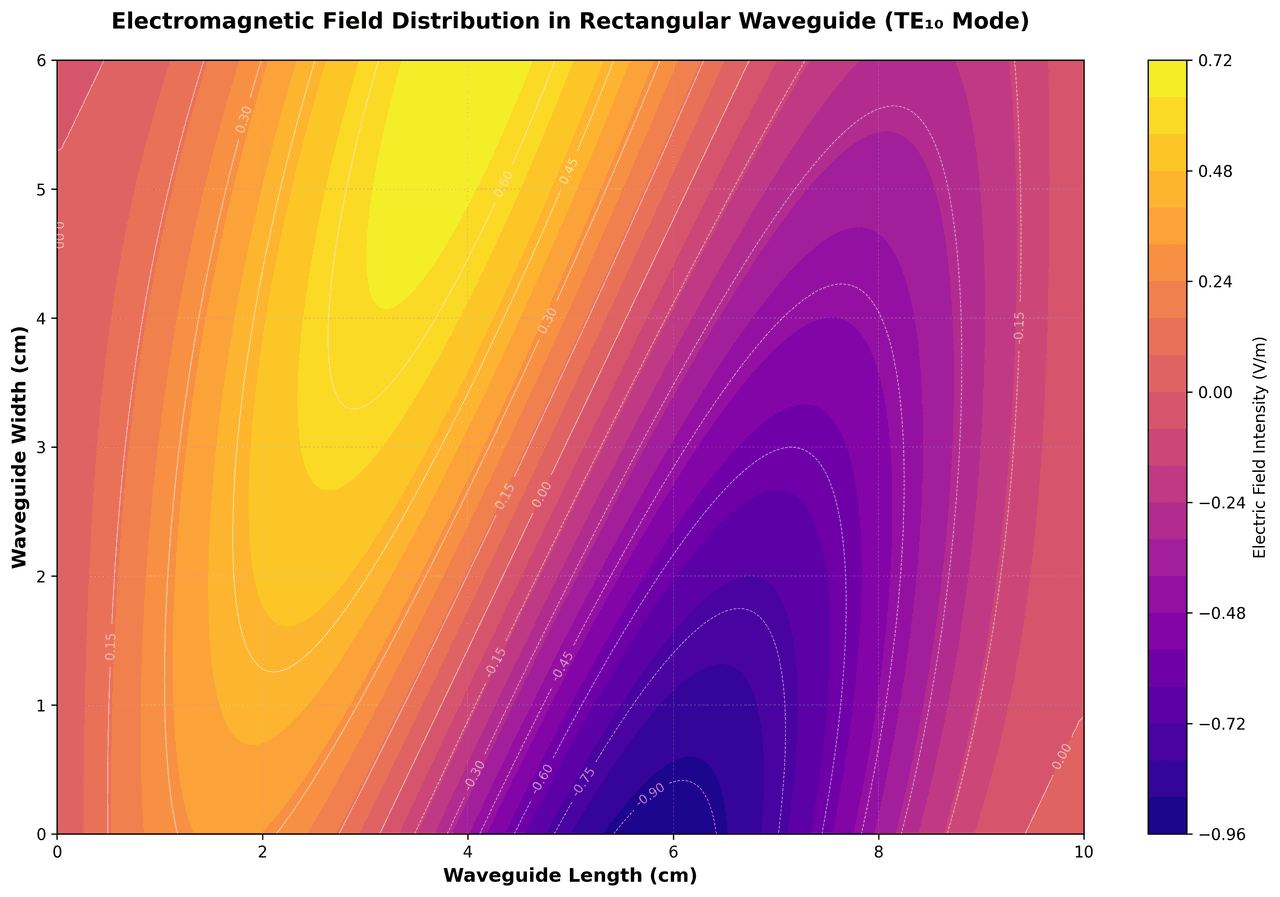
Contour maps represent three-dimensional surfaces on a two-dimensional plane using lines that connect points of equal value (isolines).
Key points
- These visualizations are essential in physics and engineering for showing electromagnetic field distributions, heat flow patterns, and pressure gradients.
- In geosciences, they display terrain elevation and atmospheric data.
- Filled contour plots enhance readability by using color gradients between contour lines, making it easy to identify regions of high and low values.
Practical guidance
Contour maps excel at revealing spatial patterns, gradients, and critical points in continuous scalar fields.
Create a Contour Map with your data using AI — no coding required.
Further reading
How to Create a Heatmap in Python
Annotated matrices, correlation heatmaps, clustering, and colorbar best practices.
Read the guideExample Visualization
Create This Chart Now
Generate publication-ready contour maps with AI in seconds. No coding required – just describe your data and let AI do the work.
View example prompt
"Create a professional contour map showing the electromagnetic field distribution in a rectangular waveguide operating in TE₁₀ mode (dominant mode). Generate a 2D grid representing the cross-section of a waveguide (10cm × 6cm). Calculate the electric field intensity pattern using the wave equation: E = sin(πx/a) × exp(-0.3y/b) × cos(0.5x - 0.3y), where a=10 (width) and b=6 (height). Use 25 filled contour levels with the 'plasma' colormap for vibrant visualization. Overlay 12 white contour lines (linewidth 0.5, alpha 0.6) and label them with field intensity values. Add a colorbar labeled 'Electric Field Intensity (V/m)'. Include axis labels: 'Waveguide Length (cm)' and 'Waveguide Width (cm)'. Title: 'Electromagnetic Field Distribution in Rectangular Waveguide (TE₁₀ Mode)'. Add a subtle grid for reference."
How to create this chart with your data
Upload Data
Upload your Excel or CSV file. Data used to generate charts is sent to Plotivy's server for processing.
AI Generation
Our AI analyzes your data and generates the Contour Map code automatically.
Customize & Export
Tweak the design with natural language, then export as high-res PNG, SVG or PDF.
Newsletter
Get one weekly tip for better contour maps
Join researchers receiving concise Python plotting techniques to improve chart clarity and reduce revision cycles.
Python Code Example
Console Output
Maximum field intensity: 0.821 V/m
Minimum field intensity: -0.819 V/m
Mean field intensity: 0.001 V/m
Field intensity range: 1.640 V/m
Common Use Cases
- 1Electromagnetic field analysis in waveguides and antennas
- 2Heat distribution and thermal analysis
- 3Terrain elevation and topographic mapping
- 4Pressure and velocity field visualization in fluid dynamics
- 5Geophysical data analysis (seismic, gravitational fields)
- 6Meteorological data (temperature, pressure systems)
Pro Tips
Use filled contours (contourf) for better visual clarity with color gradients
Label contour lines for precise value reading
Choose colormaps appropriate for your data (sequential for one direction, diverging for bidirectional)
Increase contour levels for smoother gradients (20-30 levels recommended)
Add grid lines to help readers locate specific regions
Frequently asked questions
When should you use a contour map?
Contour maps represent three-dimensional surfaces on a two-dimensional plane using lines that connect points of equal value (isolines). These visualizations are essential in physics and engineering for showing electromagnetic field distributions, heat flow patterns, and pressure gradients. Common applications include electromagnetic field analysis in waveguides and antennas, heat distribution and thermal analysis, and terrain elevation and topographic mapping.
Which Python libraries can create a contour map?
A contour map can be built in Python with matplotlib, plotly, and numpy — matplotlib for precise control over axes, annotations, and journal styling, Plotly for interactive hover, zoom, and web sharing, and numpy. In Plotivy you describe the figure and it writes the matplotlib code for you.
Can I make a contour map without writing Python code?
Yes. Describe the contour map you need in plain language and upload your dataset — Plotivy's AI writes the Python code and renders a publication-ready figure. You still get the full, editable matplotlib source, so nothing is locked in a black box.
What are best practices for a clear contour map?
Use filled contours (contourf) for better visual clarity with color gradients. Label contour lines for precise value reading.
Library comparison for this chart
matplotlib
Best when you need full control over axis formatting, annotation placement, and journal-specific styling for contour-map.
plotly
Best for interactive hover, zoom, and web sharing when collaborators need to inspect values directly from contour-map figures.
numpy
Useful in specialized workflows that complement core Python plotting libraries for contour-map analysis tasks.
Scientific Chart Selection Cheat Sheet
Not sure whether to use a Violin Plot, Box Plot, or Ridge Plot? Download our single-page reference mapping the most-used scientific chart types, exactly when to use them, and the core Matplotlib/Seaborn functions.