Marginal Histogram
Chart overview
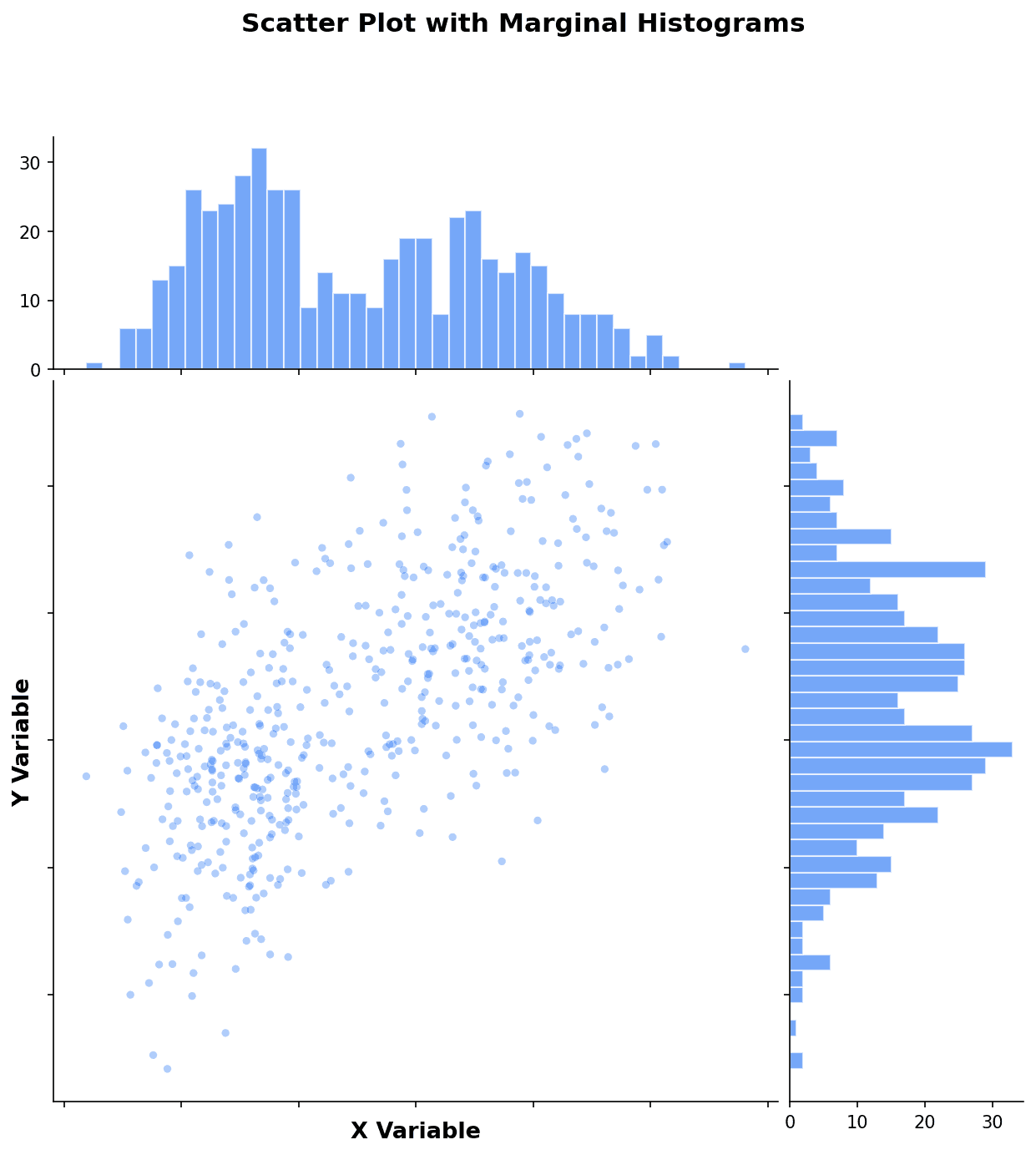
A marginal histogram plot (also called a joint distribution plot) adds histograms or kernel density estimates to the top and right margins of a central scatter plot, providing a complete picture of the bivariate relationship.
Key points
- The central scatter shows the joint distribution and correlation structure between two variables, while the marginal panels reveal the univariate distribution of each variable independently - including skewness, modality, and outliers.
- This composite figure is more informative than either the scatter or histograms alone.
- In biology, marginal histograms are used to display the relationship between two experimental measurements - such as protein abundance vs.
Practical guidance
mRNA expression from proteogenomic studies, two flow cytometry channels from multiparameter immunophenotyping, or two morphological features from ImageJ analysis - while simultaneously communicating the marginal distributions. The marginal KDE can be split and colored by grouping variable to show how different populations contribute to the joint scatter.
Create a Marginal Histogram with your data using AI — no coding required.
Further reading
How to Plot a Histogram in Python
Bin selection, KDE overlays, normality checks, and publication formatting.
Read the guideExample Visualization
Create This Chart Now
Generate publication-ready marginal histograms with AI in seconds. No coding required – just describe your data and let AI do the work.
View example prompt
"Create a marginal histogram figure from my proteogenomic data comparing mRNA expression and protein abundance. Place the scatter plot in the center, a histogram on the top margin for mRNA, and a histogram on the right margin for protein. Color points by sample tissue type. Add a Pearson correlation coefficient and p-value annotation to the scatter. Use a shared color palette between the scatter and marginal histograms. Format for publication at 300 DPI."
How to create this chart with your data
Upload Data
Upload your Excel or CSV file. Data used to generate charts is sent to Plotivy's server for processing.
AI Generation
Our AI analyzes your data and generates the Marginal Histogram code automatically.
Customize & Export
Tweak the design with natural language, then export as high-res PNG, SVG or PDF.
Newsletter
Get one weekly tip for better marginal histograms
Join researchers receiving concise Python plotting techniques to improve chart clarity and reduce revision cycles.
Python Code Example
Console Output
Figure saved: plotivy-marginal-histogram.png
Common Use Cases
- 1Proteogenomics: comparing matched mRNA and protein abundance across samples from TCGA or CPTAC
- 2Metabolomics: joint distribution of two metabolite concentrations colored by patient disease group
- 3Flow cytometry biplot: displaying two channel intensities with marginal distributions per population
- 4Ecological data: body size vs. metabolic rate scatter with taxon-colored density margins
Pro Tips
Align the axes of the marginal panels precisely with the central scatter for accurate visual mapping
Use the same color scheme for grouped data in both the scatter and the marginal histograms
Add a regression line or ellipse of concentration to the scatter to guide interpretation of the correlation
Consider using KDE instead of histograms for the margins when the sample size is small to smooth out noise
Frequently asked questions
When should you use a marginal histogram?
A marginal histogram plot (also called a joint distribution plot) adds histograms or kernel density estimates to the top and right margins of a central scatter plot, providing a complete picture of the bivariate relationship. The central scatter shows the joint distribution and correlation structure between two variables, while the marginal panels reveal the univariate distribution of each variable independently - including skewness, modality, and outliers. Common applications include proteogenomics: comparing matched mRNA and protein abundance across samples from TCGA or CPTAC, metabolomics: joint distribution of two metabolite concentrations colored by patient disease group, and flow cytometry biplot: displaying two channel intensities with marginal distributions per population.
Which Python libraries can create a marginal histogram?
A marginal histogram can be built in Python with matplotlib, numpy, and pandas — matplotlib for precise control over axes, annotations, and journal styling, numpy, and pandas for quick plots straight from a DataFrame. In Plotivy you describe the figure and it writes the matplotlib code for you.
Can I make a marginal histogram without writing Python code?
Yes. Describe the marginal histogram you need in plain language and upload your dataset — Plotivy's AI writes the Python code and renders a publication-ready figure. You still get the full, editable matplotlib source, so nothing is locked in a black box.
What are best practices for a clear marginal histogram?
Align the axes of the marginal panels precisely with the central scatter for accurate visual mapping. Use the same color scheme for grouped data in both the scatter and the marginal histograms.
Library comparison for this chart
matplotlib
Best when you need full control over axis formatting, annotation placement, and journal-specific styling for marginal-histogram.
numpy
Useful in specialized workflows that complement core Python plotting libraries for marginal-histogram analysis tasks.
pandas
Good for quick exploratory drafts directly from DataFrame operations before polishing in matplotlib or plotly.
Scientific Chart Selection Cheat Sheet
Not sure whether to use a Violin Plot, Box Plot, or Ridge Plot? Download our single-page reference mapping the most-used scientific chart types, exactly when to use them, and the core Matplotlib/Seaborn functions.