Attention Heatmap
Chart overview
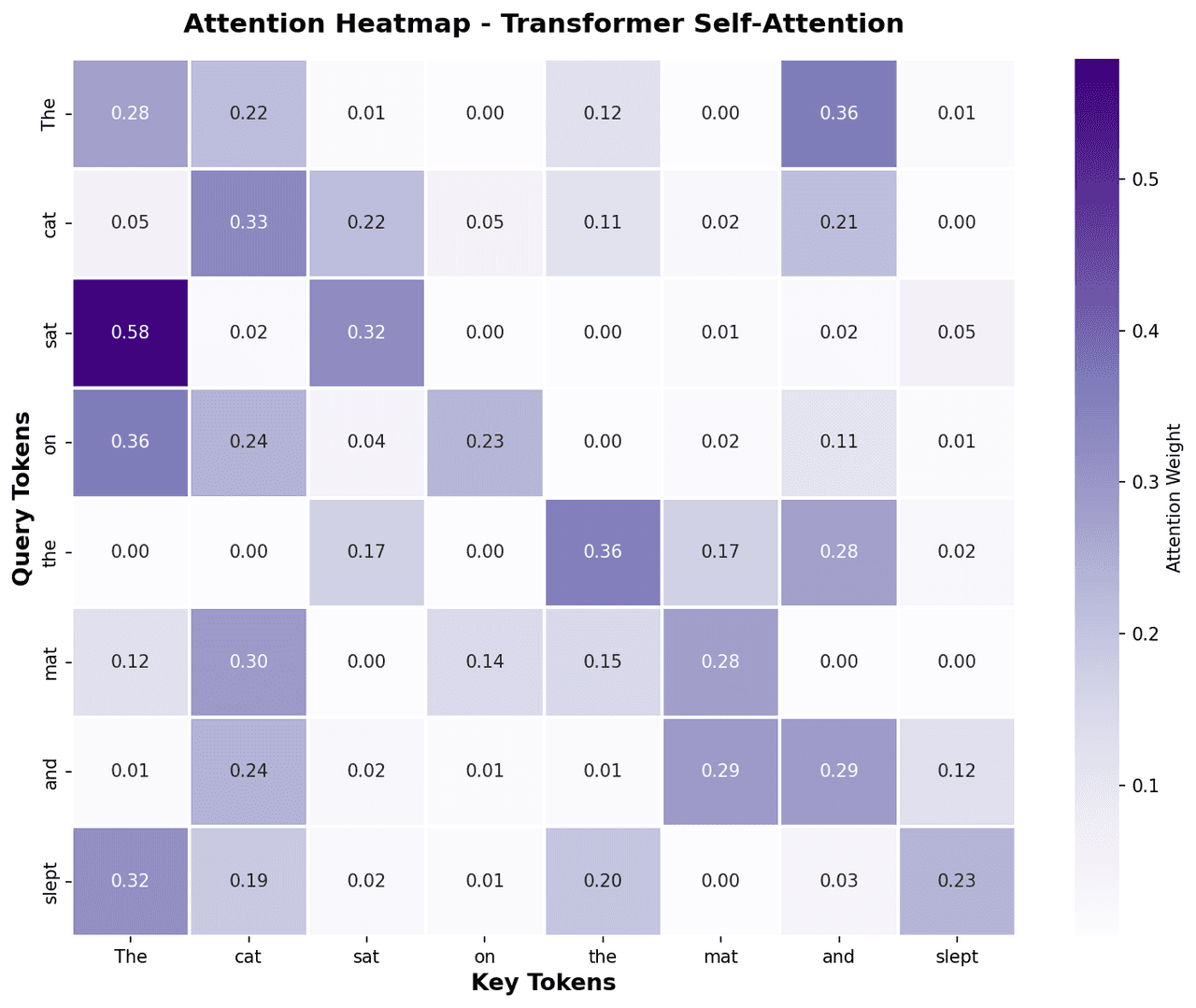
Attention heatmaps render the weight matrix that a transformer's attention head assigns between every input token pair, revealing which parts of a sequence the model focuses on.
Key points
- Researchers use them to interpret language model behavior, debug unexpected predictions, and communicate model reasoning in scientific NLP papers.
- They are equally applicable to biological sequence models and vision transformers.
Create a Attention Heatmap with your data using AI — no coding required.
Further reading
How to Create a Heatmap in Python
Annotated matrices, correlation heatmaps, clustering, and colorbar best practices.
Read the guideExample Visualization
Create This Chart Now
Generate publication-ready attention heatmaps with AI in seconds. No coding required – just describe your data and let AI do the work.
View example prompt
"Create an attention heatmap from my attention weight matrix. Label both axes with token strings, use a sequential colormap (viridis or YlOrRd), annotate cells with weight values rounded to 2 decimal places, and add a colorbar. Show one attention head per subplot if multiple heads are provided."
How to create this chart with your data
Upload Data
Upload your Excel or CSV file. Data used to generate charts is sent to Plotivy's server for processing.
AI Generation
Our AI analyzes your data and generates the Attention Heatmap code automatically.
Customize & Export
Tweak the design with natural language, then export as high-res PNG, SVG or PDF.
Newsletter
Get one weekly tip for better attention heatmaps
Join researchers receiving concise Python plotting techniques to improve chart clarity and reduce revision cycles.
Python Code Example
Console Output
Figure saved: plotivy-attention-heatmap.png
Common Use Cases
- 1Inspecting which input tokens a BERT model attends to when predicting a masked word
- 2Debugging cross-attention alignment in a neural machine translation model
- 3Visualizing structural attention patterns in protein language models
- 4Comparing attention distributions across multiple heads in a vision transformer
Pro Tips
Normalize each row to sum to 1 so each token attention distribution is comparable
Use a log scale for attention weights when values are heavily skewed toward a few tokens
Display multiple heads in a grid subplot to identify head specialization patterns
Mask the upper or lower triangle for causal models to reflect true information flow
Frequently asked questions
When should you use an attention heatmap?
Attention heatmaps render the weight matrix that a transformer's attention head assigns between every input token pair, revealing which parts of a sequence the model focuses on. Researchers use them to interpret language model behavior, debug unexpected predictions, and communicate model reasoning in scientific NLP papers. Common applications include inspecting which input tokens a BERT model attends to when predicting a masked word, debugging cross-attention alignment in a neural machine translation model, and visualizing structural attention patterns in protein language models.
Which Python libraries can create an attention heatmap?
An attention heatmap can be built in Python with matplotlib and numpy — matplotlib for precise control over axes, annotations, and journal styling and numpy. In Plotivy you describe the figure and it writes the matplotlib code for you.
Can I make an attention heatmap without writing Python code?
Yes. Describe the attention heatmap you need in plain language and upload your dataset — Plotivy's AI writes the Python code and renders a publication-ready figure. You still get the full, editable matplotlib source, so nothing is locked in a black box.
What are best practices for a clear attention heatmap?
Normalize each row to sum to 1 so each token attention distribution is comparable. Use a log scale for attention weights when values are heavily skewed toward a few tokens.
Library comparison for this chart
matplotlib
Best when you need full control over axis formatting, annotation placement, and journal-specific styling for attention-heatmap.
numpy
Useful in specialized workflows that complement core Python plotting libraries for attention-heatmap analysis tasks.
Scientific Chart Selection Cheat Sheet
Not sure whether to use a Violin Plot, Box Plot, or Ridge Plot? Download our single-page reference mapping the most-used scientific chart types, exactly when to use them, and the core Matplotlib/Seaborn functions.