Chromatogram
Chart overview
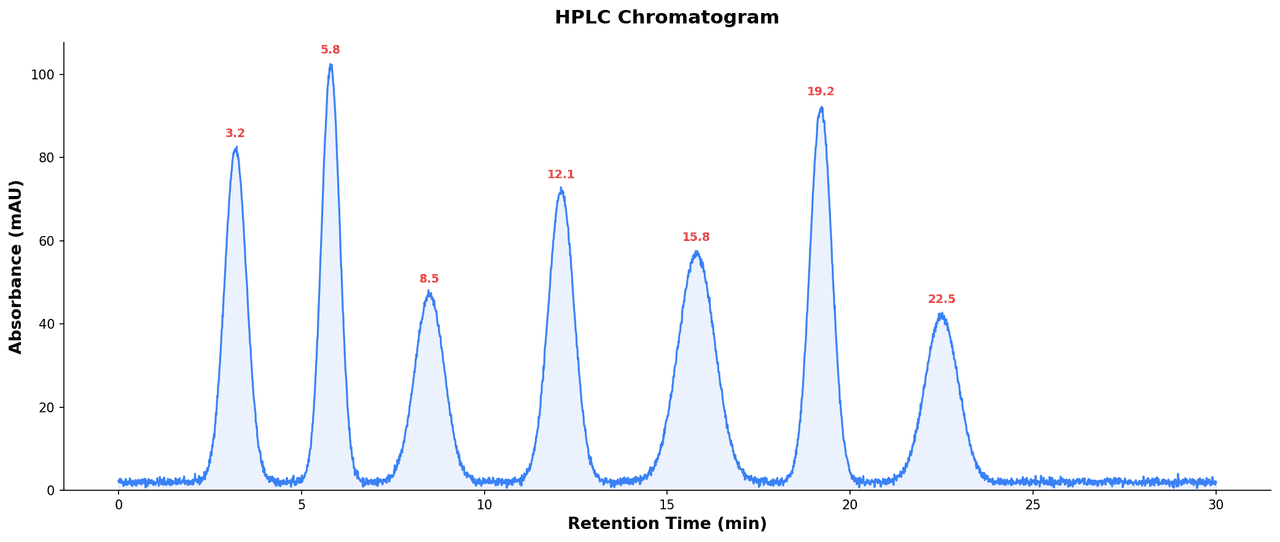
Chromatograms display detector signal (UV absorbance, flame ionization, or mass ion current) as a function of retention time, enabling identification and quantification of separated mixture components.
Key points
- Analytical chemists annotate each eluting peak with compound name, retention time, and integrated area or percentage to report purity and composition.
- Resolution, tailing factor, and theoretical plates are calculated from peak shape parameters for method validation reports.
Create a Chromatogram with your data using AI — no coding required.
Further reading
Complete Guide to Scientific Data Visualization
Chart selection, figure design, and publication-ready workflows for scientific teams.
Read the guideExample Visualization
Create This Chart Now
Generate publication-ready chromatograms with AI in seconds. No coding required – just describe your data and let AI do the work.
View example prompt
"Create a chromatogram from my data. Plot retention time (minutes) on the x-axis and detector response on the y-axis as a continuous line. Detect and annotate each peak with its retention time label and shade the peak area with a light fill. Add a flat baseline at zero and use journal formatting with Arial font and no top or right spines."
How to create this chart with your data
Upload Data
Upload your Excel or CSV file. Data used to generate charts is sent to Plotivy's server for processing.
AI Generation
Our AI analyzes your data and generates the Chromatogram code automatically.
Customize & Export
Tweak the design with natural language, then export as high-res PNG, SVG or PDF.
Newsletter
Get one weekly tip for better chromatograms
Join researchers receiving concise Python plotting techniques to improve chart clarity and reduce revision cycles.
Python Code Example
Console Output
Figure saved: plotivy-chromatogram.png
Common Use Cases
- 1Determining purity and identifying impurity peaks in pharmaceutical API lots
- 2Quantifying amino acid or metabolite concentrations in biological samples
- 3Monitoring reaction progress and product formation over time by repeated injection
- 4Method development and validation for food safety contaminant analysis
Pro Tips
Use scipy.signal.find_peaks with a minimum height and prominence to automate peak detection
Shade each integrated peak area with a unique color at low alpha to distinguish compounds visually
Include a system suitability table (resolution, tailing factor) as a text box inset on the figure
Overlay a blank or reagent blank chromatogram to identify solvent or matrix interference peaks
Frequently asked questions
When should you use a chromatogram?
Chromatograms display detector signal (UV absorbance, flame ionization, or mass ion current) as a function of retention time, enabling identification and quantification of separated mixture components. Analytical chemists annotate each eluting peak with compound name, retention time, and integrated area or percentage to report purity and composition. Common applications include determining purity and identifying impurity peaks in pharmaceutical API lots, quantifying amino acid or metabolite concentrations in biological samples, and monitoring reaction progress and product formation over time by repeated injection.
Which Python libraries can create a chromatogram?
A chromatogram can be built in Python with matplotlib, numpy, and scipy — matplotlib for precise control over axes, annotations, and journal styling, numpy, and scipy. In Plotivy you describe the figure and it writes the matplotlib code for you.
Can I make a chromatogram without writing Python code?
Yes. Describe the chromatogram you need in plain language and upload your dataset — Plotivy's AI writes the Python code and renders a publication-ready figure. You still get the full, editable matplotlib source, so nothing is locked in a black box.
What are best practices for a clear chromatogram?
Use scipy.signal.find_peaks with a minimum height and prominence to automate peak detection. Shade each integrated peak area with a unique color at low alpha to distinguish compounds visually.
Library comparison for this chart
matplotlib
Best when you need full control over axis formatting, annotation placement, and journal-specific styling for chromatogram.
numpy
Useful in specialized workflows that complement core Python plotting libraries for chromatogram analysis tasks.
scipy
Useful in specialized workflows that complement core Python plotting libraries for chromatogram analysis tasks.
Scientific Chart Selection Cheat Sheet
Not sure whether to use a Violin Plot, Box Plot, or Ridge Plot? Download our single-page reference mapping the most-used scientific chart types, exactly when to use them, and the core Matplotlib/Seaborn functions.