Circos Plot
Chart overview
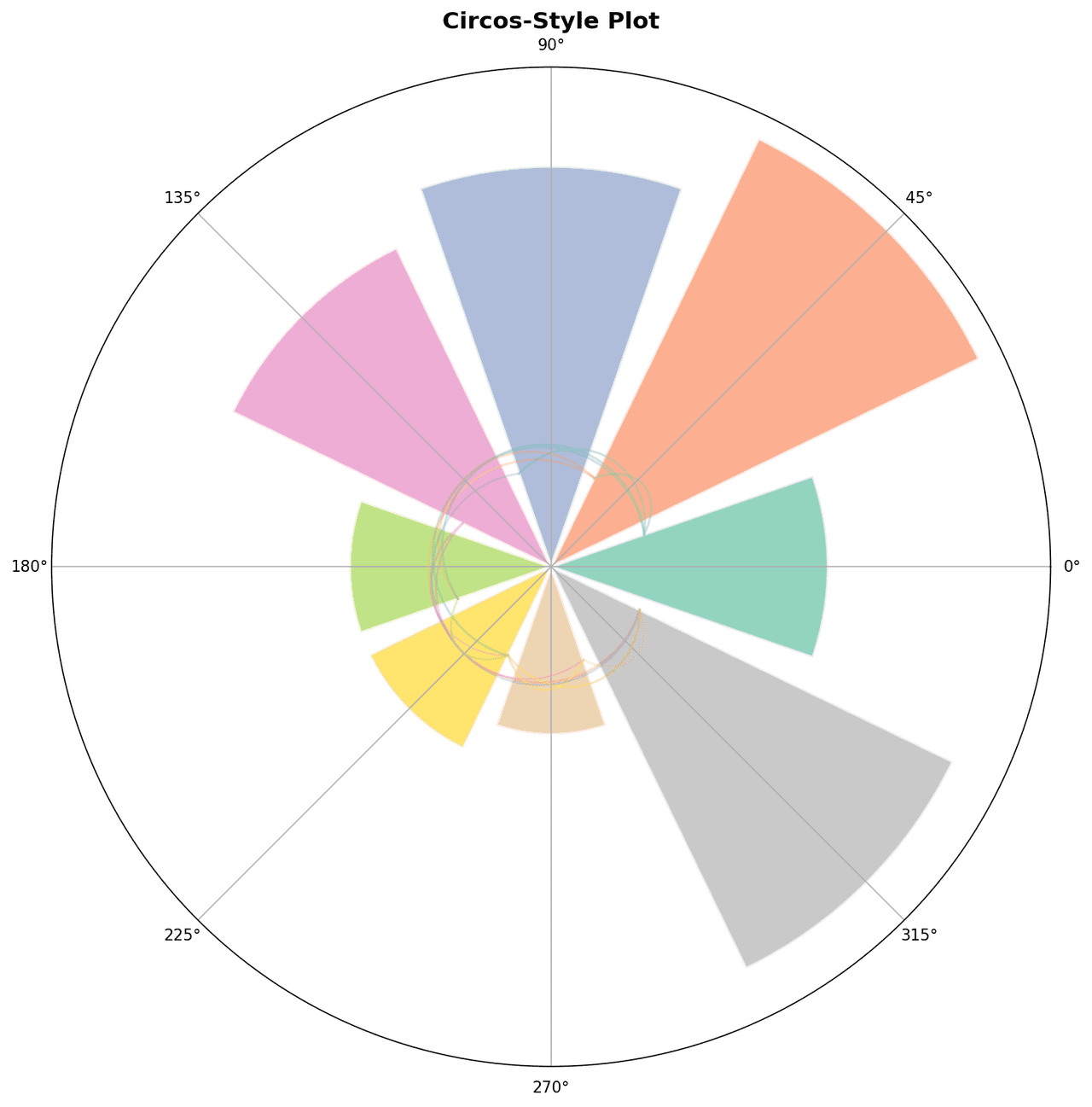
A Circos plot arranges chromosomes or genomic sequences in a circle (the ideogram) and draws links between genomic regions as ribbons across the interior, making it possible to display chromosomal rearrangements, translocations, copy number variations, syntenic regions between species, and long-range chromatin interactions in Hi-C data in a single compact figure.
Key points
- Outer concentric tracks around the ideogram can display data such as gene density, GC content, SNP density, or ChIP-seq signal as histograms, heat maps, or scatter tracks.
- The circular layout naturally removes the linearity bias of linear genome plots and places all chromosomes at equal visual prominence.
- Circos plots are used in cancer genomics to illustrate the structural variant landscape of tumor genomes, in comparative genomics to display synteny between species, and in 3D genomics to visualize TAD boundaries and chromatin interaction frequency.
Practical guidance
Python implementations such as pyCirclize or matplotlib-based approaches replicate the essential features of the original Perl-based Circos tool.
Create a Circos Plot with your data using AI — no coding required.
Further reading
Python Scatter Plot Tutorial
Build scatter plots with regression overlays, color encodings, and uncertainty bars.
Read the guideExample Visualization
Create This Chart Now
Generate publication-ready circos plots with AI in seconds. No coding required – just describe your data and let AI do the work.
View example prompt
"Create a Circos plot from my structural variant data showing chromosomal translocations between human chromosomes 1-22 plus X and Y. Draw each chromosome as an arc of the outer ideogram sized by chromosomal length. Draw ribbon links for each translocation colored by the source chromosome. Add an outer track showing gene density as a histogram. Use a dark background with white chromosome labels. Format for a Cancer Cell figure at 300 DPI."
How to create this chart with your data
Upload Data
Upload your Excel or CSV file. Data used to generate charts is sent to Plotivy's server for processing.
AI Generation
Our AI analyzes your data and generates the Circos Plot code automatically.
Customize & Export
Tweak the design with natural language, then export as high-res PNG, SVG or PDF.
Newsletter
Get one weekly tip for better circos plots
Join researchers receiving concise Python plotting techniques to improve chart clarity and reduce revision cycles.
Python Code Example
Console Output
Figure saved: plotivy-circos-plot.png
Common Use Cases
- 1Cancer genomics: displaying the structural variant and chromosomal rearrangement landscape of tumor genomes
- 2Comparative genomics: showing syntenic regions and chromosomal inversions between two species
- 3Hi-C data visualization: displaying inter-chromosomal chromatin interaction frequencies
- 4Microbial genomics: visualizing plasmid gene transfer events and mobile genetic elements across genomes
Pro Tips
Scale chromosome arc lengths proportionally to actual chromosome size for accurate representation
Limit ribbons to the most biologically significant events - too many links create an uninterpretable tangle
Use distinct colors per source chromosome so ribbon origin is identifiable without labels
Add outer data tracks sparingly - one or two tracks keep the plot readable; more creates visual overload
Frequently asked questions
When should you use a circos plot?
A Circos plot arranges chromosomes or genomic sequences in a circle (the ideogram) and draws links between genomic regions as ribbons across the interior, making it possible to display chromosomal rearrangements, translocations, copy number variations, syntenic regions between species, and long-range chromatin interactions in Hi-C data in a single compact figure. Outer concentric tracks around the ideogram can display data such as gene density, GC content, SNP density, or ChIP-seq signal as histograms, heat maps, or scatter tracks. Common applications include cancer genomics: displaying the structural variant and chromosomal rearrangement landscape of tumor genomes, comparative genomics: showing syntenic regions and chromosomal inversions between two species, and hi-C data visualization: displaying inter-chromosomal chromatin interaction frequencies.
Which Python libraries can create a circos plot?
A circos plot can be built in Python with matplotlib, numpy, and pandas — matplotlib for precise control over axes, annotations, and journal styling, numpy, and pandas for quick plots straight from a DataFrame. In Plotivy you describe the figure and it writes the matplotlib code for you.
Can I make a circos plot without writing Python code?
Yes. Describe the circos plot you need in plain language and upload your dataset — Plotivy's AI writes the Python code and renders a publication-ready figure. You still get the full, editable matplotlib source, so nothing is locked in a black box.
What are best practices for a clear circos plot?
Scale chromosome arc lengths proportionally to actual chromosome size for accurate representation. Limit ribbons to the most biologically significant events - too many links create an uninterpretable tangle.
Library comparison for this chart
matplotlib
Best when you need full control over axis formatting, annotation placement, and journal-specific styling for circos-plot.
numpy
Useful in specialized workflows that complement core Python plotting libraries for circos-plot analysis tasks.
pandas
Good for quick exploratory drafts directly from DataFrame operations before polishing in matplotlib or plotly.
Scientific Chart Selection Cheat Sheet
Not sure whether to use a Violin Plot, Box Plot, or Ridge Plot? Download our single-page reference mapping the most-used scientific chart types, exactly when to use them, and the core Matplotlib/Seaborn functions.