Cyclic Voltammogram
Chart overview
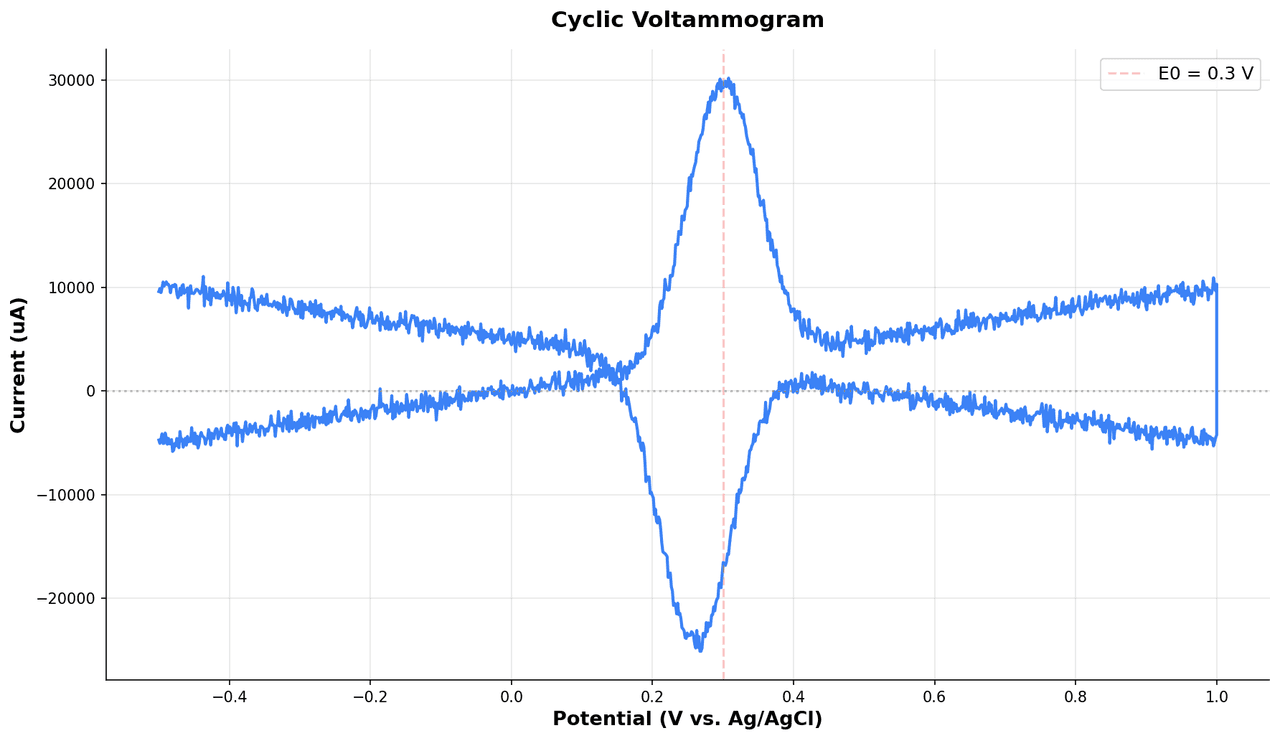
Cyclic voltammetry (CV) is the most widely used electroanalytical technique, sweeping electrode potential back and forth while recording current to reveal oxidation and reduction peaks, their positions, and their relative magnitudes.
Key points
- Peak separation diagnoses reaction reversibility, peak current scales with scan rate to distinguish adsorption from diffusion-controlled processes, and the potential window defines the stability limit of the electrolyte.
- CV is central to characterizing battery electrode materials, evaluating electrocatalysts, studying molecular redox chemistry, and measuring capacitance in supercapacitors.
Create a Cyclic Voltammogram with your data using AI — no coding required.
Further reading
Complete Guide to Scientific Data Visualization
Chart selection, figure design, and publication-ready workflows for scientific teams.
Read the guideExample Visualization
Create This Chart Now
Generate publication-ready cyclic voltammograms with AI in seconds. No coding required – just describe your data and let AI do the work.
View example prompt
"Create a publication-quality cyclic voltammogram from my CV data. Plot current (mA or mA/cm^2) on the y-axis versus potential (V vs. reference electrode, e.g., vs. RHE or vs. Ag/AgCl) on the x-axis. Add directional arrows indicating the forward and reverse potential sweeps. Annotate the anodic peak potential (Epa) and cathodic peak potential (Epc) with their current values. If multiple scan rates are included, overlay them in a color gradient from slow to fast with a legend. Add a horizontal dashed line at zero current, axis labels with units, and a descriptive title. White background."
How to create this chart with your data
Upload Data
Upload your Excel or CSV file. Data used to generate charts is sent to Plotivy's server for processing.
AI Generation
Our AI analyzes your data and generates the Cyclic Voltammogram code automatically.
Customize & Export
Tweak the design with natural language, then export as high-res PNG, SVG or PDF.
Newsletter
Get one weekly tip for better cyclic voltammograms
Join researchers receiving concise Python plotting techniques to improve chart clarity and reduce revision cycles.
Python Code Example
Console Output
Figure saved: plotivy-cv-voltammogram.png
Common Use Cases
- 1Identifying redox-active species and their formal potentials in electrolyte solutions
- 2Evaluating pseudocapacitive charge storage contributions in battery electrode materials
- 3Screening electrocatalysts for oxygen reduction or hydrogen evolution activity
- 4Determining the electrochemical stability window of new ionic liquid electrolytes
Pro Tips
Add directional arrows on the CV trace to show the potential sweep direction clearly
Annotate anodic (Epa) and cathodic (Epc) peak positions and calculate peak separation for reversibility
Use consistent colors when overlaying multiple scan rates, from light (slow) to dark (fast)
Normalize current to electrode area (mA/cm^2) or active mass (A/g) for fair comparison
Frequently asked questions
When should you use a cyclic voltammogram?
Cyclic voltammetry (CV) is the most widely used electroanalytical technique, sweeping electrode potential back and forth while recording current to reveal oxidation and reduction peaks, their positions, and their relative magnitudes. Peak separation diagnoses reaction reversibility, peak current scales with scan rate to distinguish adsorption from diffusion-controlled processes, and the potential window defines the stability limit of the electrolyte. Common applications include identifying redox-active species and their formal potentials in electrolyte solutions, evaluating pseudocapacitive charge storage contributions in battery electrode materials, and screening electrocatalysts for oxygen reduction or hydrogen evolution activity.
Which Python libraries can create a cyclic voltammogram?
A cyclic voltammogram can be built in Python with matplotlib and numpy — matplotlib for precise control over axes, annotations, and journal styling and numpy. In Plotivy you describe the figure and it writes the matplotlib code for you.
Can I make a cyclic voltammogram without writing Python code?
Yes. Describe the cyclic voltammogram you need in plain language and upload your dataset — Plotivy's AI writes the Python code and renders a publication-ready figure. You still get the full, editable matplotlib source, so nothing is locked in a black box.
What are best practices for a clear cyclic voltammogram?
Add directional arrows on the CV trace to show the potential sweep direction clearly. Annotate anodic (Epa) and cathodic (Epc) peak positions and calculate peak separation for reversibility.
Library comparison for this chart
matplotlib
Best when you need full control over axis formatting, annotation placement, and journal-specific styling for cv-voltammogram.
numpy
Useful in specialized workflows that complement core Python plotting libraries for cv-voltammogram analysis tasks.
Scientific Chart Selection Cheat Sheet
Not sure whether to use a Violin Plot, Box Plot, or Ridge Plot? Download our single-page reference mapping the most-used scientific chart types, exactly when to use them, and the core Matplotlib/Seaborn functions.