Fan Chart
Chart overview
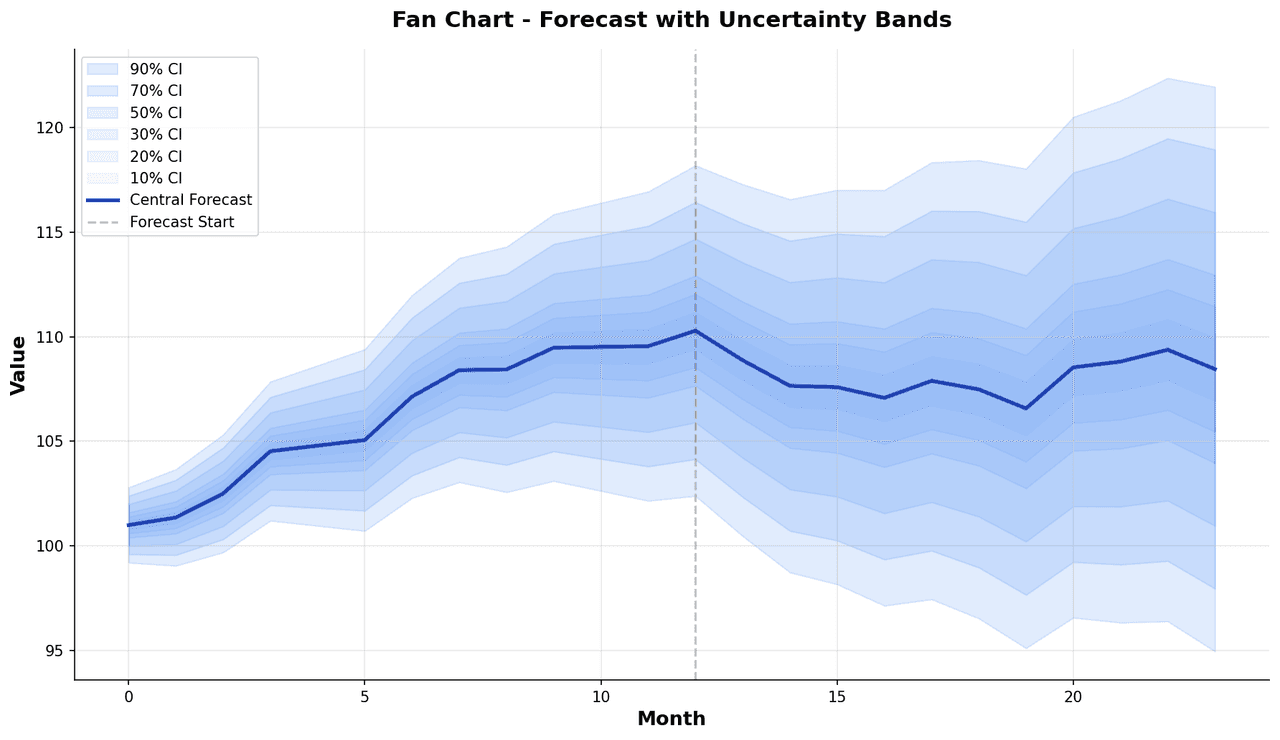
A fan chart overlays multiple nested confidence or prediction intervals around a forecast trajectory, with progressively lighter shading at wider probability levels, creating a fan-like shape that widens with forecast horizon.
Key points
- Climate scientists, epidemiologists, and economists use it to communicate both the central projection and the growing uncertainty of model-based forecasts.
- It is more informative than a single confidence band because it conveys the full probability distribution of future outcomes.
Create a Fan Chart with your data using AI — no coding required.
Further reading
How to Create a Bar Chart in Python
Matplotlib, seaborn, and plotly patterns for grouped bars, error bars, and publication-ready labels.
Read the guideExample Visualization
Create This Chart Now
Generate publication-ready fan charts with AI in seconds. No coding required – just describe your data and let AI do the work.
View example prompt
"Create a fan chart from my forecast data. Plot a solid central estimate line, shade nested prediction intervals at 50%, 80%, and 95% with progressively lighter fills, mark the forecast horizon with a vertical dashed line, and format as a publication-quality figure."
How to create this chart with your data
Upload Data
Upload your Excel or CSV file. Data used to generate charts is sent to Plotivy's server for processing.
AI Generation
Our AI analyzes your data and generates the Fan Chart code automatically.
Customize & Export
Tweak the design with natural language, then export as high-res PNG, SVG or PDF.
Newsletter
Get one weekly tip for better fan charts
Join researchers receiving concise Python plotting techniques to improve chart clarity and reduce revision cycles.
Python Code Example
Console Output
Figure saved: plotivy-fan-chart.png
Common Use Cases
- 1Displaying ensemble climate model temperature projections with uncertainty bands
- 2Showing epidemiological disease incidence forecasts with credible intervals
- 3Communicating economic GDP growth projections from central bank models
- 4Presenting Bayesian pharmacokinetic model time-course predictions with posteriors
Pro Tips
Use at least three nested bands at distinct probability levels such as 50%, 80%, and 95%
Choose fill colours from a single hue at different opacities rather than multiple hues
Separate the historical observed period from the forecast period with a vertical dashed line
Include a clear legend mapping each shaded band to its probability level
Frequently asked questions
When should you use a fan chart?
A fan chart overlays multiple nested confidence or prediction intervals around a forecast trajectory, with progressively lighter shading at wider probability levels, creating a fan-like shape that widens with forecast horizon. Climate scientists, epidemiologists, and economists use it to communicate both the central projection and the growing uncertainty of model-based forecasts. Common applications include displaying ensemble climate model temperature projections with uncertainty bands, showing epidemiological disease incidence forecasts with credible intervals, and communicating economic GDP growth projections from central bank models.
Which Python libraries can create a fan chart?
A fan chart can be built in Python with matplotlib and numpy — matplotlib for precise control over axes, annotations, and journal styling and numpy. In Plotivy you describe the figure and it writes the matplotlib code for you.
Can I make a fan chart without writing Python code?
Yes. Describe the fan chart you need in plain language and upload your dataset — Plotivy's AI writes the Python code and renders a publication-ready figure. You still get the full, editable matplotlib source, so nothing is locked in a black box.
What are best practices for a clear fan chart?
Use at least three nested bands at distinct probability levels such as 50%, 80%, and 95%. Choose fill colours from a single hue at different opacities rather than multiple hues.
Library comparison for this chart
matplotlib
Best when you need full control over axis formatting, annotation placement, and journal-specific styling for fan-chart.
numpy
Useful in specialized workflows that complement core Python plotting libraries for fan-chart analysis tasks.
Scientific Chart Selection Cheat Sheet
Not sure whether to use a Violin Plot, Box Plot, or Ridge Plot? Download our single-page reference mapping the most-used scientific chart types, exactly when to use them, and the core Matplotlib/Seaborn functions.