Hysteresis Loop
Chart overview
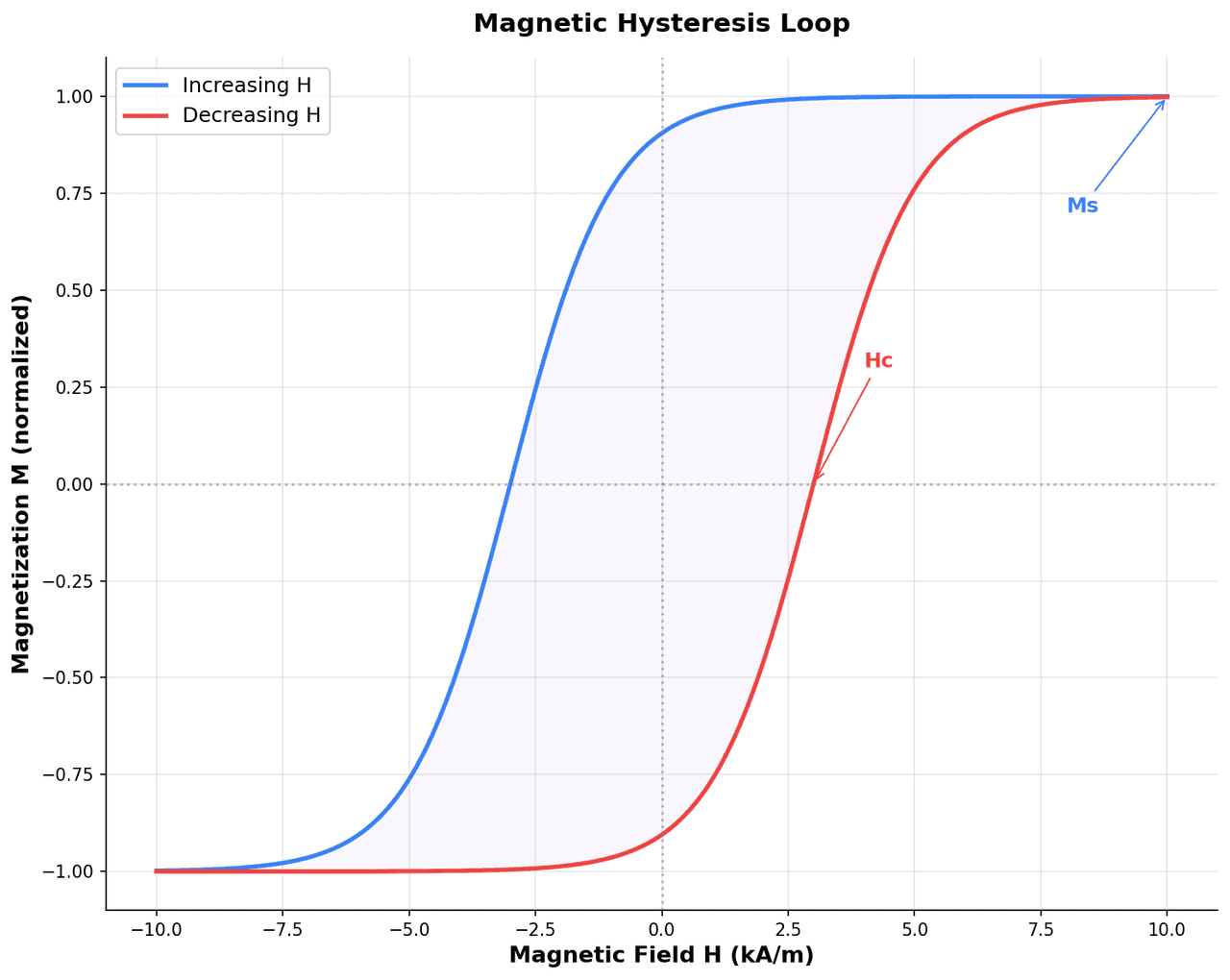
Hysteresis loops are the primary characterization tool for magnetic materials, obtained from vibrating sample magnetometry (VSM) or SQUID magnetometry.
Key points
- The loop shape encodes the coercive field, remanent magnetization, saturation magnetization, and energy dissipation per cycle, all of which determine suitability for permanent magnets, data storage media, or soft-core transformers.
- Loop squareness, exchange bias shifts, and minor loop behavior provide deeper insight into magnetic anisotropy, domain wall pinning, and interfacial exchange coupling.
Create a Hysteresis Loop with your data using AI — no coding required.
Further reading
Complete Guide to Scientific Data Visualization
Chart selection, figure design, and publication-ready workflows for scientific teams.
Read the guideExample Visualization
Create This Chart Now
Generate publication-ready hysteresis loops with AI in seconds. No coding required – just describe your data and let AI do the work.
View example prompt
"Create a publication-quality magnetic hysteresis loop from my VSM data. Plot magnetization M (emu/g or A/m) on the y-axis versus applied field H (Oe or kA/m) on the x-axis. Draw the complete closed loop with arrows indicating the field sweep direction. Annotate key parameters: coercive field Hc, remanent magnetization Mr, and saturation magnetization Ms with dashed guide lines. Add horizontal and vertical reference lines at zero. Use axis labels with units, a legend, and a descriptive title. Use a white background with professional styling."
How to create this chart with your data
Upload Data
Upload your Excel or CSV file. Data used to generate charts is sent to Plotivy's server for processing.
AI Generation
Our AI analyzes your data and generates the Hysteresis Loop code automatically.
Customize & Export
Tweak the design with natural language, then export as high-res PNG, SVG or PDF.
Newsletter
Get one weekly tip for better hysteresis loops
Join researchers receiving concise Python plotting techniques to improve chart clarity and reduce revision cycles.
Python Code Example
Console Output
Figure saved: plotivy-hysteresis-loop.png
Common Use Cases
- 1Characterizing permanent magnet materials (NdFeB, SmCo) for energy product BHmax
- 2Evaluating exchange bias in ferromagnet/antiferromagnet thin film bilayers
- 3Screening soft magnetic materials for transformer core loss minimization
- 4Monitoring magnetic annealing effects on coercivity in nanocomposite films
Pro Tips
Plot both forward and backward field sweeps on the same axes to form a closed loop
Add directional arrows on the loop to indicate the magnetization sweep direction
Annotate Hc, Mr, and Ms with horizontal and vertical dashed reference lines
For minor loops, overlay multiple loops with different maximum fields in distinct colors
Frequently asked questions
When should you use a hysteresis loop?
Hysteresis loops are the primary characterization tool for magnetic materials, obtained from vibrating sample magnetometry (VSM) or SQUID magnetometry. The loop shape encodes the coercive field, remanent magnetization, saturation magnetization, and energy dissipation per cycle, all of which determine suitability for permanent magnets, data storage media, or soft-core transformers. Common applications include characterizing permanent magnet materials (NdFeB, SmCo) for energy product BHmax, evaluating exchange bias in ferromagnet/antiferromagnet thin film bilayers, and screening soft magnetic materials for transformer core loss minimization.
Which Python libraries can create a hysteresis loop?
A hysteresis loop can be built in Python with matplotlib and numpy — matplotlib for precise control over axes, annotations, and journal styling and numpy. In Plotivy you describe the figure and it writes the matplotlib code for you.
Can I make a hysteresis loop without writing Python code?
Yes. Describe the hysteresis loop you need in plain language and upload your dataset — Plotivy's AI writes the Python code and renders a publication-ready figure. You still get the full, editable matplotlib source, so nothing is locked in a black box.
What are best practices for a clear hysteresis loop?
Plot both forward and backward field sweeps on the same axes to form a closed loop. Add directional arrows on the loop to indicate the magnetization sweep direction.
Library comparison for this chart
matplotlib
Best when you need full control over axis formatting, annotation placement, and journal-specific styling for hysteresis-loop.
numpy
Useful in specialized workflows that complement core Python plotting libraries for hysteresis-loop analysis tasks.
Scientific Chart Selection Cheat Sheet
Not sure whether to use a Violin Plot, Box Plot, or Ridge Plot? Download our single-page reference mapping the most-used scientific chart types, exactly when to use them, and the core Matplotlib/Seaborn functions.