Impedance Spectrum
Chart overview
Electrochemical impedance spectroscopy (EIS) probes the frequency-dependent response of electrochemical systems, separating ohmic resistance, charge transfer kinetics, and mass transport contributions.
Key points
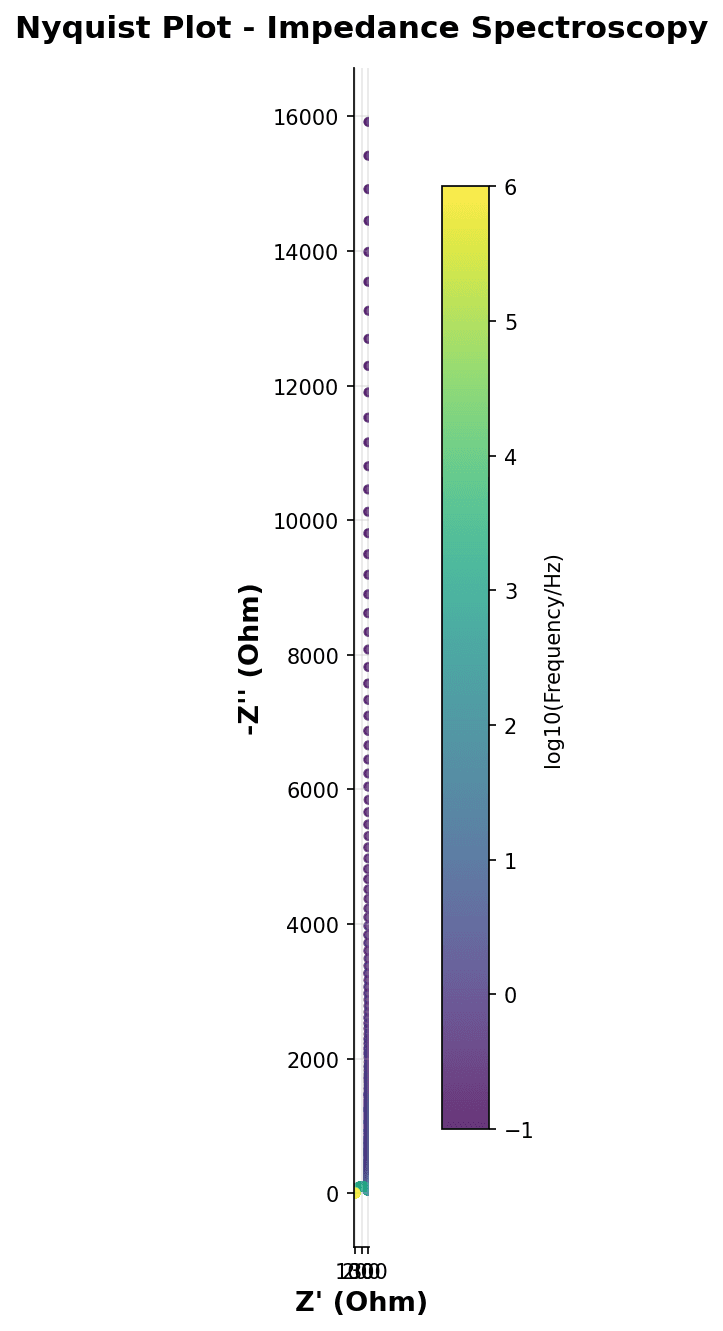
- The Nyquist plot shows imaginary versus real impedance as semicircles and Warburg tails, while the Bode plot displays impedance magnitude and phase angle versus frequency.
- EIS is indispensable for characterizing batteries, fuel cells, supercapacitors, corrosion inhibition, biosensors, and solid electrolytes, enabling equivalent circuit modeling and mechanistic understanding without destructive testing.
Create a Impedance Spectrum with your data using AI — no coding required.
Further reading
Complete Guide to Scientific Data Visualization
Chart selection, figure design, and publication-ready workflows for scientific teams.
Read the guideExample Visualization
Create This Chart Now
Generate publication-ready impedance spectrums with AI in seconds. No coding required – just describe your data and let AI do the work.
View example prompt
"Create a publication-quality electrochemical impedance spectrum from my EIS data. Generate a Nyquist plot with -Z'' (imaginary impedance, Ohm) on the y-axis and Z' (real impedance, Ohm) on the x-axis. Ensure the y-axis is positive upward for -Z''. Use equal aspect ratio. Optionally add a Bode plot panel showing |Z| (Ohm) and phase angle (degrees) versus frequency (Hz) on a logarithmic x-axis. Fit and overlay an equivalent circuit model curve if circuit parameters are provided. Annotate key features: high-frequency intercept (Rs), semicircle diameter (Rct), and low-frequency Warburg region. White background."
How to create this chart with your data
Upload Data
Upload your Excel or CSV file. Data used to generate charts is sent to Plotivy's server for processing.
AI Generation
Our AI analyzes your data and generates the Impedance Spectrum code automatically.
Customize & Export
Tweak the design with natural language, then export as high-res PNG, SVG or PDF.
Newsletter
Get one weekly tip for better impedance spectrums
Join researchers receiving concise Python plotting techniques to improve chart clarity and reduce revision cycles.
Python Code Example
Console Output
Figure saved: plotivy-impedance-spectrum.png
Common Use Cases
- 1Determining charge transfer resistance and double layer capacitance in battery electrodes
- 2Evaluating solid electrolyte ionic conductivity and grain boundary resistance
- 3Monitoring corrosion inhibitor effectiveness via polarization resistance changes
- 4Characterizing proton exchange membrane fuel cell degradation mechanisms
Pro Tips
Always use an equal aspect ratio on the Nyquist plot to correctly identify semicircles
Plot -Z'' (not Z'') on the y-axis so semicircles appear above the x-axis by convention
Use logarithmic frequency axis on Bode plots to span the full measurement range
Overlay the equivalent circuit fit curve and report fitted parameters in a table inset
Frequently asked questions
When should you use an impedance spectrum?
Electrochemical impedance spectroscopy (EIS) probes the frequency-dependent response of electrochemical systems, separating ohmic resistance, charge transfer kinetics, and mass transport contributions. The Nyquist plot shows imaginary versus real impedance as semicircles and Warburg tails, while the Bode plot displays impedance magnitude and phase angle versus frequency. Common applications include determining charge transfer resistance and double layer capacitance in battery electrodes, evaluating solid electrolyte ionic conductivity and grain boundary resistance, and monitoring corrosion inhibitor effectiveness via polarization resistance changes.
Which Python libraries can create an impedance spectrum?
An impedance spectrum can be built in Python with matplotlib and numpy — matplotlib for precise control over axes, annotations, and journal styling and numpy. In Plotivy you describe the figure and it writes the matplotlib code for you.
Can I make an impedance spectrum without writing Python code?
Yes. Describe the impedance spectrum you need in plain language and upload your dataset — Plotivy's AI writes the Python code and renders a publication-ready figure. You still get the full, editable matplotlib source, so nothing is locked in a black box.
What are best practices for a clear impedance spectrum?
Always use an equal aspect ratio on the Nyquist plot to correctly identify semicircles. Plot -Z'' (not Z'') on the y-axis so semicircles appear above the x-axis by convention.
Library comparison for this chart
matplotlib
Best when you need full control over axis formatting, annotation placement, and journal-specific styling for impedance-spectrum.
numpy
Useful in specialized workflows that complement core Python plotting libraries for impedance-spectrum analysis tasks.
Scientific Chart Selection Cheat Sheet
Not sure whether to use a Violin Plot, Box Plot, or Ridge Plot? Download our single-page reference mapping the most-used scientific chart types, exactly when to use them, and the core Matplotlib/Seaborn functions.