Manhattan Plot
Chart overview
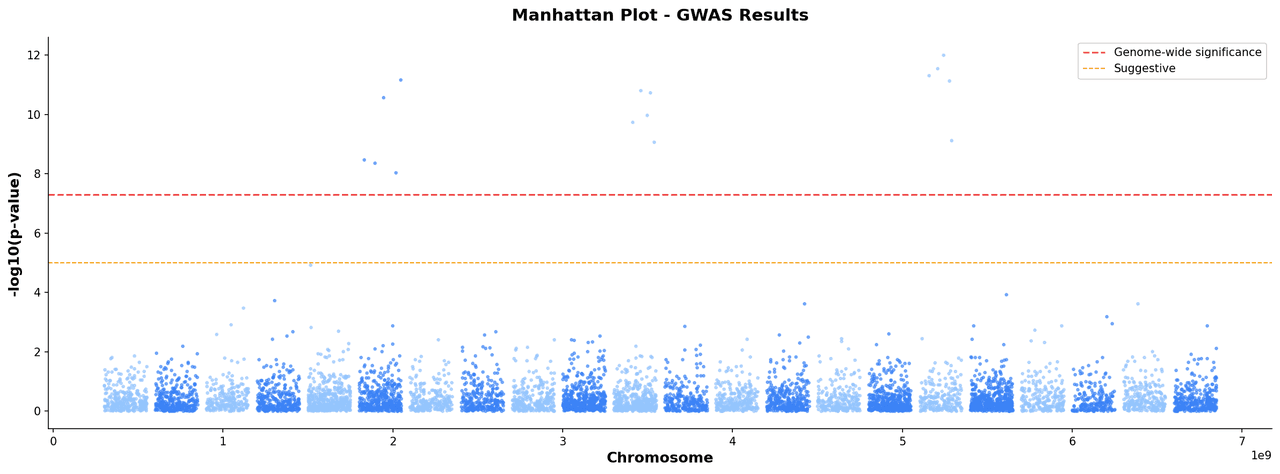
The Manhattan plot is the canonical visualization for genome-wide association studies (GWAS).
Key points
- Each point represents a single nucleotide polymorphism (SNP) positioned on the x-axis by chromosomal coordinate and on the y-axis by -log10 of its association p-value with a phenotype of interest.
- The alternating color scheme across chromosomes helps distinguish adjacent chromosome boundaries.
- Two horizontal reference lines are universally used: a suggestive threshold at p = 1e-5 (yellow) and a genome-wide significant threshold at p = 5e-8 (red), the latter correcting for the approximately one million independent tests in a typical array-based GWAS.
Practical guidance
Peaks that breach the genome-wide threshold are candidate loci for follow-up fine-mapping, functional annotation, and replication. The plot communicates both the overall inflation of test statistics (genomic inflation factor lambda) and the specific location of hits across the genome.
Create a Manhattan Plot with your data using AI — no coding required.
Further reading
Python Scatter Plot Tutorial
Build scatter plots with regression overlays, color encodings, and uncertainty bars.
Read the guideExample Visualization
Create This Chart Now
Generate publication-ready manhattan plots with AI in seconds. No coding required – just describe your data and let AI do the work.
View example prompt
"Create a Manhattan plot from my GWAS summary statistics file with columns: CHR, BP, SNP, P. Plot -log10(P) on the y-axis and chromosomal position on the x-axis. Alternate blue and navy colors between chromosomes. Add a red dashed line at genome-wide significance (p=5e-8) and a grey dashed line at suggestive significance (p=1e-5). Highlight and label the top significant SNPs at each locus. Format for Nature Genetics publication standards at 300 DPI."
How to create this chart with your data
Upload Data
Upload your Excel or CSV file. Data used to generate charts is sent to Plotivy's server for processing.
AI Generation
Our AI analyzes your data and generates the Manhattan Plot code automatically.
Customize & Export
Tweak the design with natural language, then export as high-res PNG, SVG or PDF.
Newsletter
Get one weekly tip for better manhattan plots
Join researchers receiving concise Python plotting techniques to improve chart clarity and reduce revision cycles.
Python Code Example
Console Output
Figure saved: plotivy-manhattan-plot.png
Common Use Cases
- 1Identifying genetic loci associated with complex traits such as height, BMI, or disease risk
- 2Pharmacogenomics: finding SNPs that predict drug response or adverse reactions
- 3Population genetics: detecting signatures of natural selection from differentiation statistics
- 4eQTL mapping: associating genetic variants with gene expression levels in GTEx-style studies
Pro Tips
Pre-filter SNPs to MAF > 1% and imputation quality > 0.8 before plotting to reduce noise
Always accompany the Manhattan plot with a Q-Q plot to assess genomic inflation
Use a regional association plot (LocusZoom-style) to zoom into significant loci for LD structure
Clump or prune correlated SNPs so that each independent signal has only one representative point
Frequently asked questions
When should you use a manhattan plot?
The Manhattan plot is the canonical visualization for genome-wide association studies (GWAS). Each point represents a single nucleotide polymorphism (SNP) positioned on the x-axis by chromosomal coordinate and on the y-axis by -log10 of its association p-value with a phenotype of interest. Common applications include identifying genetic loci associated with complex traits such as height, BMI, or disease risk, pharmacogenomics: finding SNPs that predict drug response or adverse reactions, and population genetics: detecting signatures of natural selection from differentiation statistics.
Which Python libraries can create a manhattan plot?
A manhattan plot can be built in Python with matplotlib, numpy, and pandas — matplotlib for precise control over axes, annotations, and journal styling, numpy, and pandas for quick plots straight from a DataFrame. In Plotivy you describe the figure and it writes the matplotlib code for you.
Can I make a manhattan plot without writing Python code?
Yes. Describe the manhattan plot you need in plain language and upload your dataset — Plotivy's AI writes the Python code and renders a publication-ready figure. You still get the full, editable matplotlib source, so nothing is locked in a black box.
What are best practices for a clear manhattan plot?
Pre-filter SNPs to MAF > 1% and imputation quality > 0.8 before plotting to reduce noise. Always accompany the Manhattan plot with a Q-Q plot to assess genomic inflation.
Library comparison for this chart
matplotlib
Best when you need full control over axis formatting, annotation placement, and journal-specific styling for manhattan-plot.
numpy
Useful in specialized workflows that complement core Python plotting libraries for manhattan-plot analysis tasks.
pandas
Good for quick exploratory drafts directly from DataFrame operations before polishing in matplotlib or plotly.
Scientific Chart Selection Cheat Sheet
Not sure whether to use a Violin Plot, Box Plot, or Ridge Plot? Download our single-page reference mapping the most-used scientific chart types, exactly when to use them, and the core Matplotlib/Seaborn functions.