Q-Q Plot
Chart overview
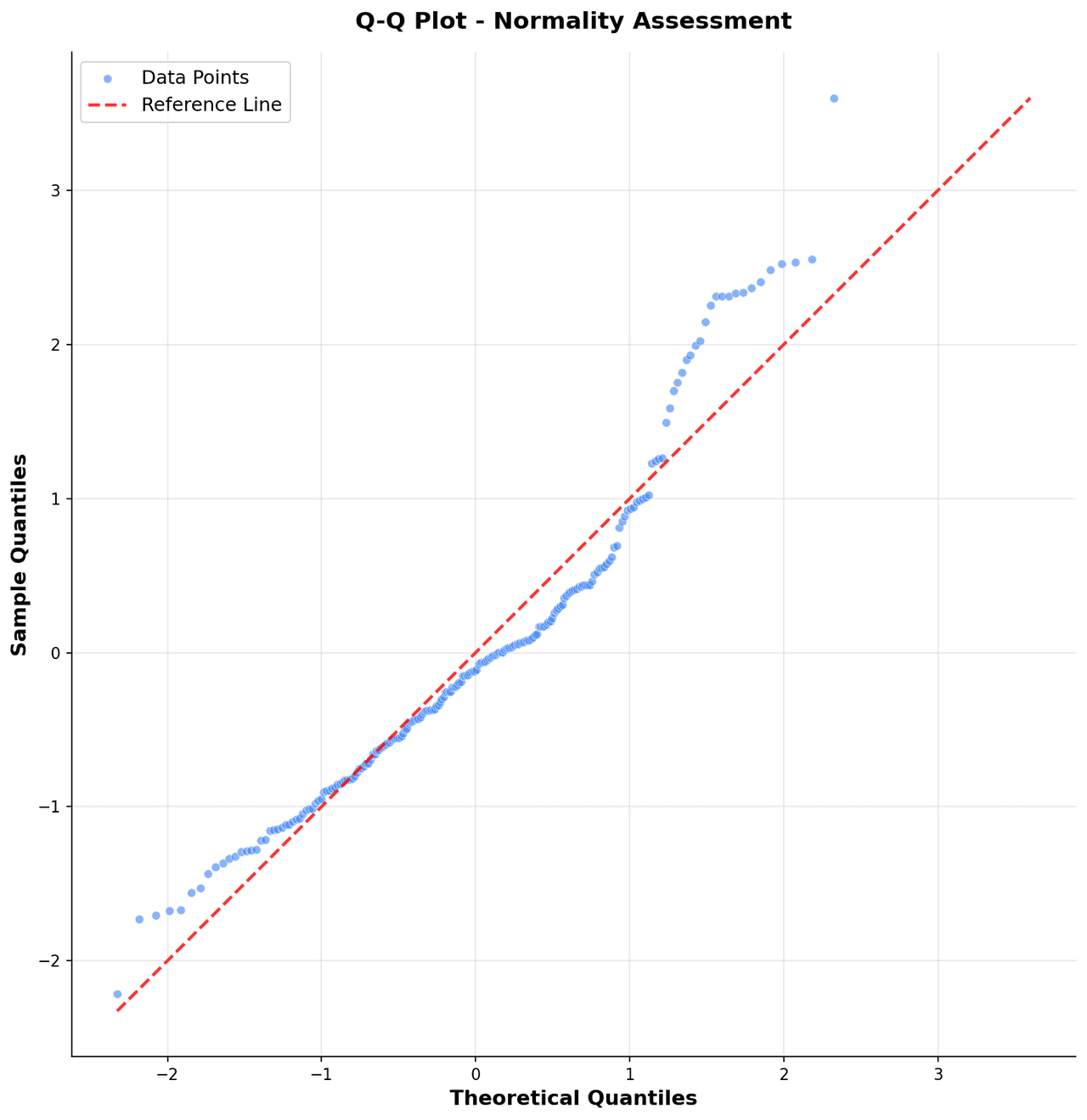
A Q-Q plot compares the quantile function of observed data against that of a reference distribution (typically normal), with deviations from the diagonal indicating skewness, heavy tails, or multimodality.
Key points
- It is a standard diagnostic in regression analysis, hypothesis test validation, and data quality assessment.
- Researchers use it to decide whether parametric tests are appropriate and to characterize the nature of distributional departures.
Create a Q-Q Plot with your data using AI — no coding required.
Further reading
Python Scatter Plot Tutorial
Build scatter plots with regression overlays, color encodings, and uncertainty bars.
Read the guideExample Visualization
Create This Chart Now
Generate publication-ready q-q plots with AI in seconds. No coding required – just describe your data and let AI do the work.
View example prompt
"Create a Q-Q plot from my data. Plot sample quantiles against normal (or specified) theoretical quantiles, add a 45-degree reference line fitted through the first and third quartiles, shade the 95% confidence band, label the axes with the distribution name, and annotate extreme points."
How to create this chart with your data
Upload Data
Upload your Excel or CSV file. Data used to generate charts is sent to Plotivy's server for processing.
AI Generation
Our AI analyzes your data and generates the Q-Q Plot code automatically.
Customize & Export
Tweak the design with natural language, then export as high-res PNG, SVG or PDF.
Newsletter
Get one weekly tip for better q-q plots
Join researchers receiving concise Python plotting techniques to improve chart clarity and reduce revision cycles.
Python Code Example
Console Output
Figure saved: plotivy-quantile-quantile-plot.png
Common Use Cases
- 1Checking normality of regression residuals before applying F-tests
- 2Assessing whether environmental concentration data follows a log-normal distribution
- 3Comparing empirical return period quantiles against a fitted GEV distribution
- 4Validating simulation model output distributions against reference datasets
Pro Tips
Fit the reference line through the 25th and 75th percentile points rather than the first and last for robustness
Use a log scale for the axes when checking log-normality to linearize the expected pattern
Add KS-statistic and p-value as an annotation to complement the visual assessment
Generate multiple Q-Q plots against different candidate distributions to select the best fit
Frequently asked questions
When should you use a q-q plot?
A Q-Q plot compares the quantile function of observed data against that of a reference distribution (typically normal), with deviations from the diagonal indicating skewness, heavy tails, or multimodality. It is a standard diagnostic in regression analysis, hypothesis test validation, and data quality assessment. Common applications include checking normality of regression residuals before applying F-tests, assessing whether environmental concentration data follows a log-normal distribution, and comparing empirical return period quantiles against a fitted GEV distribution.
Which Python libraries can create a q-q plot?
A q-q plot can be built in Python with matplotlib and numpy — matplotlib for precise control over axes, annotations, and journal styling and numpy. In Plotivy you describe the figure and it writes the matplotlib code for you.
Can I make a q-q plot without writing Python code?
Yes. Describe the q-q plot you need in plain language and upload your dataset — Plotivy's AI writes the Python code and renders a publication-ready figure. You still get the full, editable matplotlib source, so nothing is locked in a black box.
What are best practices for a clear q-q plot?
Fit the reference line through the 25th and 75th percentile points rather than the first and last for robustness. Use a log scale for the axes when checking log-normality to linearize the expected pattern.
Library comparison for this chart
matplotlib
Best when you need full control over axis formatting, annotation placement, and journal-specific styling for quantile-quantile-plot.
numpy
Useful in specialized workflows that complement core Python plotting libraries for quantile-quantile-plot analysis tasks.
Scientific Chart Selection Cheat Sheet
Not sure whether to use a Violin Plot, Box Plot, or Ridge Plot? Download our single-page reference mapping the most-used scientific chart types, exactly when to use them, and the core Matplotlib/Seaborn functions.