Empirical CDF
Chart overview
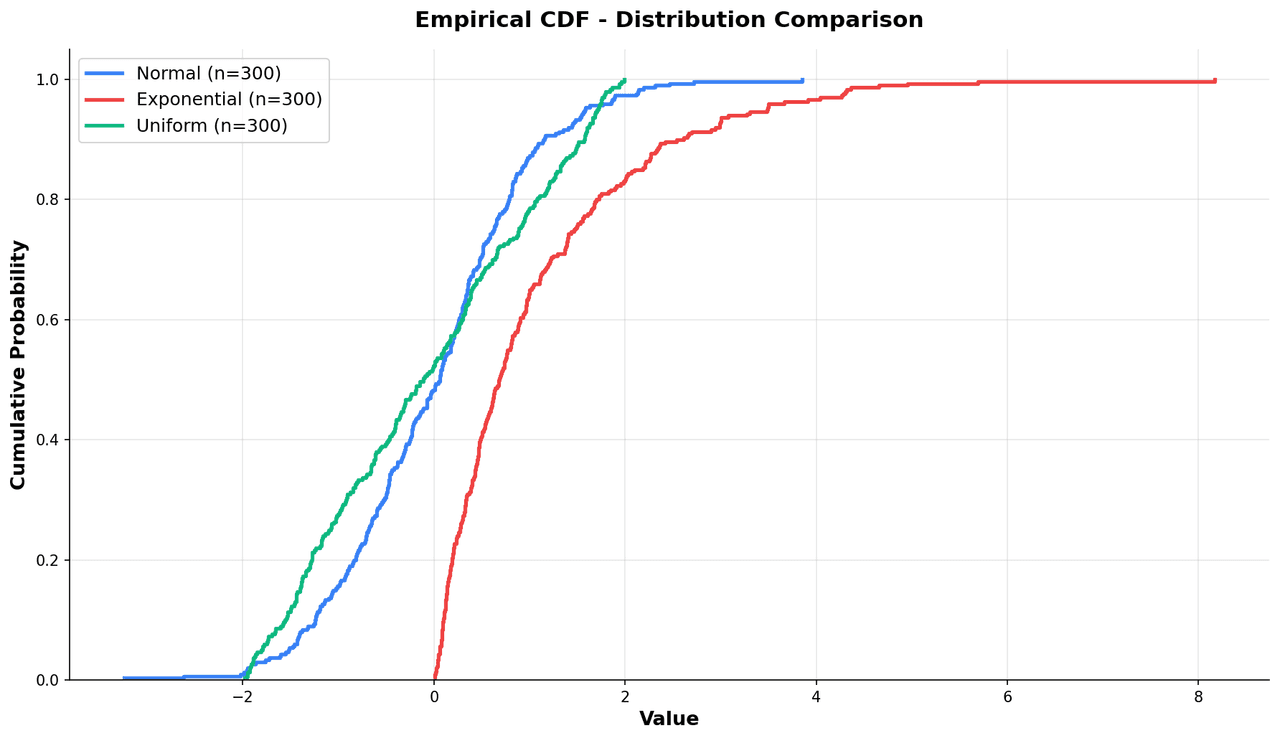
The empirical CDF plots each sorted observation against its cumulative probability, producing a step function that converges to the true CDF with increasing sample size.
Key points
- Unlike histograms, the ECDF requires no binning decisions and retains all data points, making it the preferred method for comparing distributions in statistics and data science.
- It is commonly used alongside the Q-Q plot and two-sample Kolmogorov-Smirnov tests to assess distributional differences.
- The killer application is comparing groups: overlaid ECDFs make it immediately visible where two distributions diverge - a horizontal gap at a given height reads as 'the same percentile occurs at a different value', and the maximum vertical gap between two curves is literally the Kolmogorov-Smirnov test statistic, so the plot is the visual companion to the KS test rather than a separate artifact.
Practical guidance
Because there is no bandwidth or bin choice, two analysts always draw the same ECDF from the same data - a reproducibility property neither histograms nor KDEs have, and the reason ECDFs are increasingly preferred in publications. seaborn's ecdfplot(data, x='value', hue='group') is the one-liner; draw true steps rather than interpolating between points, since the step function is the actual empirical distribution and smoothing it fabricates values. For heavy-tailed data (latencies, incomes, particle sizes) put the x-axis on a log scale - the ECDF handles this cleanly where histogram bins fight you. The honest trade-off: ECDFs make percentiles, medians, and stochastic dominance easy to read but modes hard - a bimodal distribution shows up only as a subtle plateau, so pair an ECDF with a histogram when the number of modes is the scientific question.
Create a Empirical CDF with your data using AI — no coding required.
Further reading
Complete Guide to Scientific Data Visualization
Chart selection, figure design, and publication-ready workflows for scientific teams.
Read the guideExample Visualization
Create This Chart Now
Generate publication-ready empirical cdfs with AI in seconds. No coding required – just describe your data and let AI do the work.
View example prompt
"Create an empirical CDF plot from my data. Plot the step function for each group or variable using distinct colors, add horizontal reference lines at the 25th, 50th, and 75th percentiles, overlay a fitted theoretical CDF if requested, and include a legend with sample sizes."
How to create this chart with your data
Upload Data
Upload your Excel or CSV file. Data used to generate charts is sent to Plotivy's server for processing.
AI Generation
Our AI analyzes your data and generates the Empirical CDF code automatically.
Customize & Export
Tweak the design with natural language, then export as high-res PNG, SVG or PDF.
Newsletter
Get one weekly tip for better empirical cdfs
Join researchers receiving concise Python plotting techniques to improve chart clarity and reduce revision cycles.
Python Code Example
Console Output
Figure saved: plotivy-empirical-cdf.png
Common Use Cases
- 1Comparing gene expression distributions across experimental conditions without histogram bins
- 2Visualizing the distribution of model prediction errors for multiple algorithms
- 3Assessing whether patient survival times differ between treatment groups
- 4Summarizing particle size distributions in materials science or soil science samples
Pro Tips
Use a steps-post draw style in Matplotlib to preserve the empirical CDF step function
Overlay groups on the same axes when direct distribution comparison is the main goal
Mark the median or quartiles with subtle reference lines when readers need exact percentiles
Pair the ECDF with a histogram when modes or distribution shape are central to the analysis
Frequently asked questions
When should you use an empirical CDF?
The empirical CDF plots each sorted observation against its cumulative probability, producing a step function that converges to the true CDF with increasing sample size. Unlike histograms, the ECDF requires no binning decisions and retains all data points, making it the preferred method for comparing distributions in statistics and data science. Common applications include comparing gene expression distributions across experimental conditions without histogram bins, visualizing the distribution of model prediction errors for multiple algorithms, and assessing whether patient survival times differ between treatment groups.
Which Python libraries can create an empirical CDF?
An empirical CDF can be built in Python with matplotlib and numpy — matplotlib for precise control over axes, annotations, and journal styling and numpy. In Plotivy you describe the figure and it writes the matplotlib code for you.
Can I make an empirical CDF without writing Python code?
Yes. Describe the empirical CDF you need in plain language and upload your dataset — Plotivy's AI writes the Python code and renders a publication-ready figure. You still get the full, editable matplotlib source, so nothing is locked in a black box.
What are best practices for a clear empirical CDF?
Use a steps-post draw style in Matplotlib to preserve the empirical CDF step function. Overlay groups on the same axes when direct distribution comparison is the main goal.
Library comparison for this chart
matplotlib
Best when you need full control over axis formatting, annotation placement, and journal-specific styling for empirical-cdf.
numpy
Useful in specialized workflows that complement core Python plotting libraries for empirical-cdf analysis tasks.
Scientific Chart Selection Cheat Sheet
Not sure whether to use a Violin Plot, Box Plot, or Ridge Plot? Download our single-page reference mapping the most-used scientific chart types, exactly when to use them, and the core Matplotlib/Seaborn functions.