Reflectance Spectrum
Chart overview
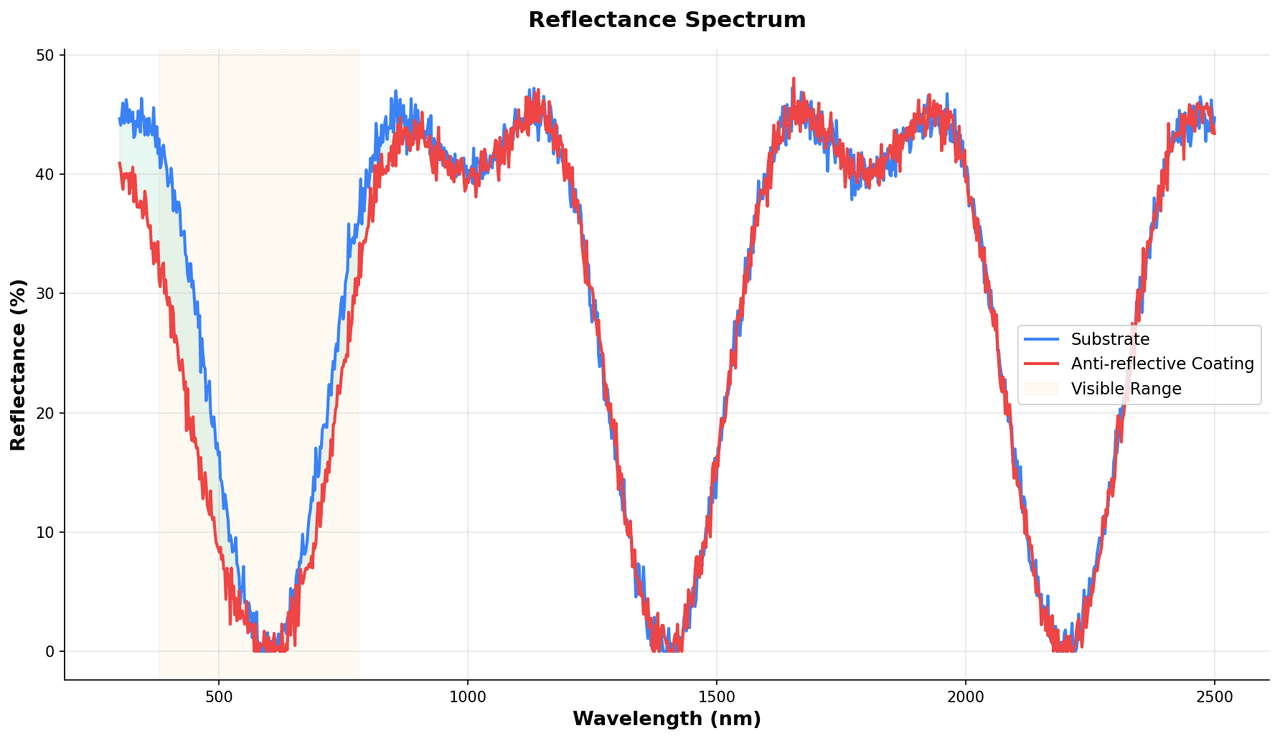
Reflectance spectra measure the fraction of incident light reflected from a surface as a function of wavelength, providing direct information about absorption edges, photonic bandgaps, surface plasmon resonances, and thin film interference.
Key points
- They complement transmission measurements where samples are opaque and are essential for characterizing mirrors, coatings, solar cell anti-reflection layers, plasmonic nanostructures, and metamaterials.
- Fabry-Perot interference fringes in the reflectance of thin films allow precise determination of film thickness when the refractive index is known.
Create a Reflectance Spectrum with your data using AI — no coding required.
Further reading
Complete Guide to Scientific Data Visualization
Chart selection, figure design, and publication-ready workflows for scientific teams.
Read the guideExample Visualization
Create This Chart Now
Generate publication-ready reflectance spectrums with AI in seconds. No coding required – just describe your data and let AI do the work.
View example prompt
"Create a publication-quality reflectance spectrum plot from my optical data. Plot reflectance (%) on the y-axis versus wavelength (nm) on the x-axis. Use a colored background shading under the curve to enhance visual impact. Annotate key spectral features: absorption edge, reflectance minima or maxima from interference fringes, or plasmonic resonance peak. If multiple samples are shown, overlay them in distinct colors with a legend. Add axis labels with units, a y-axis range of 0-100%, and a descriptive title. Use a white background with professional styling."
How to create this chart with your data
Upload Data
Upload your Excel or CSV file. Data used to generate charts is sent to Plotivy's server for processing.
AI Generation
Our AI analyzes your data and generates the Reflectance Spectrum code automatically.
Customize & Export
Tweak the design with natural language, then export as high-res PNG, SVG or PDF.
Newsletter
Get one weekly tip for better reflectance spectrums
Join researchers receiving concise Python plotting techniques to improve chart clarity and reduce revision cycles.
Python Code Example
Console Output
Figure saved: plotivy-reflectance-spectrum.png
Common Use Cases
- 1Characterizing distributed Bragg reflector multilayer stacks for laser mirror design
- 2Measuring localized surface plasmon resonance wavelength of gold or silver nanoparticles
- 3Evaluating anti-reflection coating performance for solar cell efficiency improvement
- 4Determining thin film thickness from Fabry-Perot interference fringe spacing
Pro Tips
Correct for baseline drift by normalizing to a reference mirror or white tile measurement
Shade the UV (< 400 nm) and IR (> 700 nm) regions lightly to indicate the visible range
Use a secondary y-axis to overlay absorbance if comparing reflection and absorption features
Annotate characteristic peaks or edges directly on the spectrum with dashed vertical lines
Frequently asked questions
When should you use a reflectance spectrum?
Reflectance spectra measure the fraction of incident light reflected from a surface as a function of wavelength, providing direct information about absorption edges, photonic bandgaps, surface plasmon resonances, and thin film interference. They complement transmission measurements where samples are opaque and are essential for characterizing mirrors, coatings, solar cell anti-reflection layers, plasmonic nanostructures, and metamaterials. Common applications include characterizing distributed Bragg reflector multilayer stacks for laser mirror design, measuring localized surface plasmon resonance wavelength of gold or silver nanoparticles, and evaluating anti-reflection coating performance for solar cell efficiency improvement.
Which Python libraries can create a reflectance spectrum?
A reflectance spectrum can be built in Python with matplotlib and numpy — matplotlib for precise control over axes, annotations, and journal styling and numpy. In Plotivy you describe the figure and it writes the matplotlib code for you.
Can I make a reflectance spectrum without writing Python code?
Yes. Describe the reflectance spectrum you need in plain language and upload your dataset — Plotivy's AI writes the Python code and renders a publication-ready figure. You still get the full, editable matplotlib source, so nothing is locked in a black box.
What are best practices for a clear reflectance spectrum?
Correct for baseline drift by normalizing to a reference mirror or white tile measurement. Shade the UV (< 400 nm) and IR (> 700 nm) regions lightly to indicate the visible range.
Library comparison for this chart
matplotlib
Best when you need full control over axis formatting, annotation placement, and journal-specific styling for reflectance-spectrum.
numpy
Useful in specialized workflows that complement core Python plotting libraries for reflectance-spectrum analysis tasks.
Scientific Chart Selection Cheat Sheet
Not sure whether to use a Violin Plot, Box Plot, or Ridge Plot? Download our single-page reference mapping the most-used scientific chart types, exactly when to use them, and the core Matplotlib/Seaborn functions.