Stress-Strain Curve
Chart overview
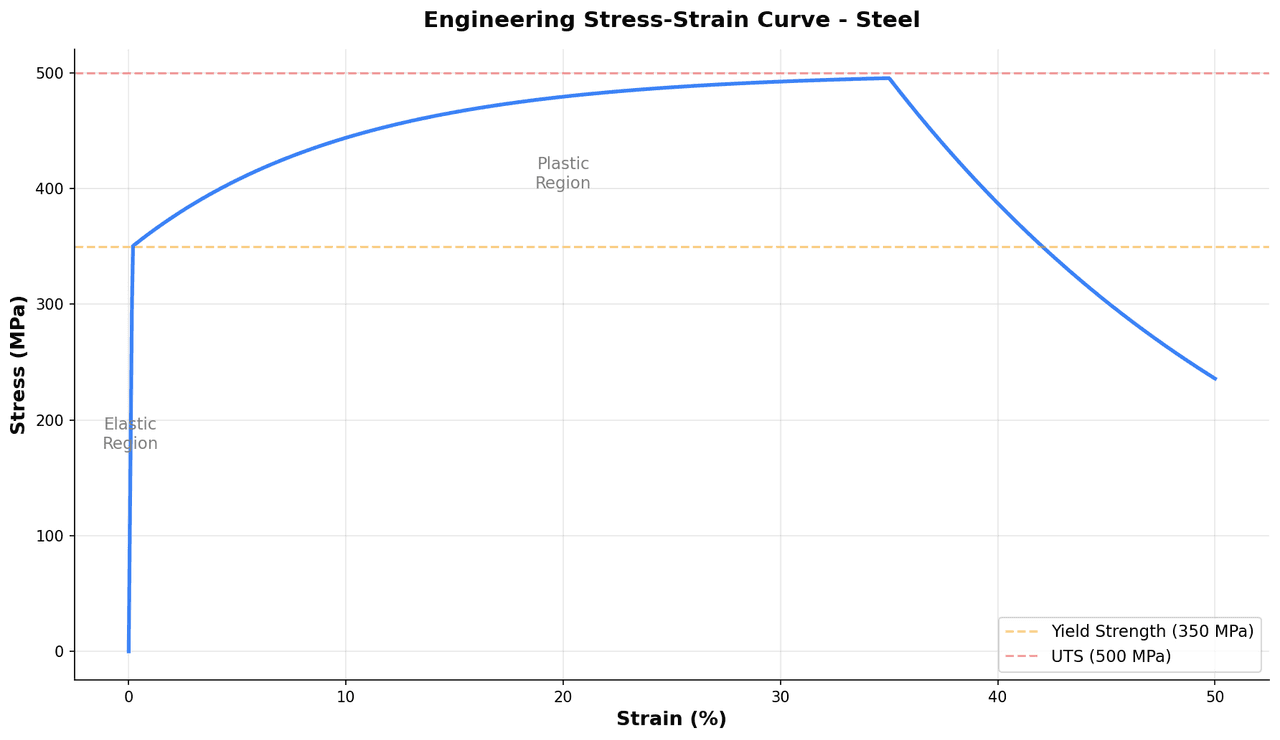
The stress-strain curve is the fundamental characterization tool for mechanical properties of materials, directly obtained from uniaxial tensile tests.
Key points
- Its elastic region slope gives Young's modulus, the yield point marks onset of plastic deformation, the ultimate tensile strength is the load-bearing maximum, and the fracture strain quantifies ductility.
- These parameters govern material selection for structural engineering, biomedical implants, aerospace components, and polymer processing, making their clear visual annotation critical for publication and engineering qualification.
Create a Stress-Strain Curve with your data using AI — no coding required.
Further reading
Complete Guide to Scientific Data Visualization
Chart selection, figure design, and publication-ready workflows for scientific teams.
Read the guideExample Visualization
Create This Chart Now
Generate publication-ready stress-strain curves with AI in seconds. No coding required – just describe your data and let AI do the work.
View example prompt
"Create a publication-quality stress-strain curve from my tensile test data. Plot engineering stress (MPa) on the y-axis versus engineering strain (%) or (mm/mm) on the x-axis. Annotate the key features: elastic modulus slope, 0.2% proof stress (yield point) with an offset line, ultimate tensile strength (UTS), and fracture point. Shade the elastic and plastic regions in different subtle colors. Add a zoom inset of the yield region if the data warrants it. Include axis labels with units, a legend if multiple samples are shown, and a descriptive title. White background, professional styling."
How to create this chart with your data
Upload Data
Upload your Excel or CSV file. Data used to generate charts is sent to Plotivy's server for processing.
AI Generation
Our AI analyzes your data and generates the Stress-Strain Curve code automatically.
Customize & Export
Tweak the design with natural language, then export as high-res PNG, SVG or PDF.
Newsletter
Get one weekly tip for better stress-strain curves
Join researchers receiving concise Python plotting techniques to improve chart clarity and reduce revision cycles.
Python Code Example
Console Output
Figure saved: plotivy-stress-strain-curve.png
Common Use Cases
- 1Qualifying structural steel grades against ASTM or ISO mechanical property standards
- 2Comparing polymer composite formulations for impact and creep resistance
- 3Evaluating strain hardening exponents for metal forming process design
- 4Measuring fracture toughness and ductile-to-brittle transition in alloys
Pro Tips
Use the 0.2% offset method line to define yield strength when there is no sharp yield point
Annotate Young's modulus as a slope triangle in the linear elastic region
Mark UTS and fracture strain with distinct symbols and callout labels
For multiple samples, use consistent colors and include a specimen ID legend
Frequently asked questions
When should you use a stress-strain curve?
The stress-strain curve is the fundamental characterization tool for mechanical properties of materials, directly obtained from uniaxial tensile tests. Its elastic region slope gives Young's modulus, the yield point marks onset of plastic deformation, the ultimate tensile strength is the load-bearing maximum, and the fracture strain quantifies ductility. Common applications include qualifying structural steel grades against ASTM or ISO mechanical property standards, comparing polymer composite formulations for impact and creep resistance, and evaluating strain hardening exponents for metal forming process design.
Which Python libraries can create a stress-strain curve?
A stress-strain curve can be built in Python with matplotlib and numpy — matplotlib for precise control over axes, annotations, and journal styling and numpy. In Plotivy you describe the figure and it writes the matplotlib code for you.
Can I make a stress-strain curve without writing Python code?
Yes. Describe the stress-strain curve you need in plain language and upload your dataset — Plotivy's AI writes the Python code and renders a publication-ready figure. You still get the full, editable matplotlib source, so nothing is locked in a black box.
What are best practices for a clear stress-strain curve?
Use the 0.2% offset method line to define yield strength when there is no sharp yield point. Annotate Young's modulus as a slope triangle in the linear elastic region.
Library comparison for this chart
matplotlib
Best when you need full control over axis formatting, annotation placement, and journal-specific styling for stress-strain-curve.
numpy
Useful in specialized workflows that complement core Python plotting libraries for stress-strain-curve analysis tasks.
Scientific Chart Selection Cheat Sheet
Not sure whether to use a Violin Plot, Box Plot, or Ridge Plot? Download our single-page reference mapping the most-used scientific chart types, exactly when to use them, and the core Matplotlib/Seaborn functions.