FTIR Spectrum
Chart overview
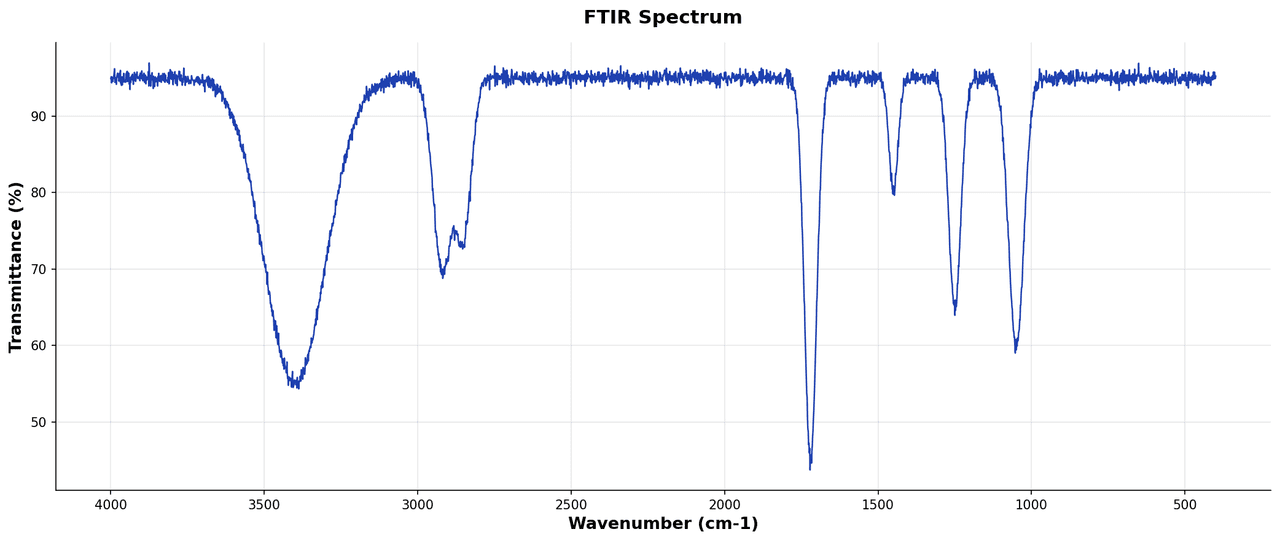
FTIR spectra reveal the infrared absorption fingerprint of a material by plotting percent transmittance or absorbance against wavenumber (cm-1), enabling identification of functional groups such as O-H, N-H, C=O, and C-O stretches.
Key points
- Polymer scientists, pharmacists, and surface chemists use FTIR to confirm synthesis, track degradation, and verify material composition.
- Annotating characteristic absorption bands against reference tables is standard practice in analytical chemistry publications.
Create a FTIR Spectrum with your data using AI — no coding required.
Further reading
Complete Guide to Scientific Data Visualization
Chart selection, figure design, and publication-ready workflows for scientific teams.
Read the guideExample Visualization
Create This Chart Now
Generate publication-ready ftir spectrums with AI in seconds. No coding required – just describe your data and let AI do the work.
View example prompt
"Create an FTIR spectrum from my data. Plot wavenumber (cm-1) on the x-axis (reversed, 4000 to 400) and percent transmittance on the y-axis. Annotate the most significant absorption peaks with their wavenumber values and corresponding functional group assignments. Add shaded regions for the fingerprint region (400-1500 cm-1). Use journal formatting with Arial font and no top or right spines."
How to create this chart with your data
Upload Data
Upload your Excel or CSV file. Data used to generate charts is sent to Plotivy's server for processing.
AI Generation
Our AI analyzes your data and generates the FTIR Spectrum code automatically.
Customize & Export
Tweak the design with natural language, then export as high-res PNG, SVG or PDF.
Newsletter
Get one weekly tip for better ftir spectrums
Join researchers receiving concise Python plotting techniques to improve chart clarity and reduce revision cycles.
Python Code Example
# === IMPORTS ===
import matplotlib.pyplot as plt
import numpy as np

# === USER-EDITABLE PARAMETERS ===
title = "FTIR Spectrum"
figsize = (14, 6)

# === EXAMPLE DATASET ===
np.random.seed(42)
wavenumber = np.linspace(400, 4000, 3000)
transmittance = 95 + np.random.normal(0, 0.5, len(wavenumber))

# Peak position, depth, and width.
peaks = [
    (3400, 40, 100),
    (2920, 25, 30),
    (2850, 20, 25),
    (1720, 50, 20),
    (1450, 15, 15),
    (1250, 30, 20),
    (1050, 35, 25),
]

for position, depth, width in peaks:
    transmittance -= depth * np.exp(-0.5 * ((wavenumber - position) / width) ** 2)

print("=== FTIR Spectrum Peaks ===")
for position, depth, width in peaks:
    print(f"{position} cm-1 | depth {depth}% | width {width} cm-1")

# === CREATE FTIR SPECTRUM ===
fig, ax = plt.subplots(figsize=figsize)

ax.plot(wavenumber, transmittance, color="#1e40af", linewidth=1.2)
ax.axvspan(400, 1500, color="gray", alpha=0.12, label="Fingerprint region")

assignments = {
    3400: "O-H / N-H",
    2920: "C-H",
    2850: "C-H",
    1720: "C=O",
    1450: "CH2 bend",
    1250: "C-O",
    1050: "C-O",
}

for position, _, _ in peaks:
    idx = np.argmin(np.abs(wavenumber - position))
    y_value = transmittance[idx]
    ax.annotate(
        f"{position} cm-1\n{assignments[position]}",
        xy=(position, y_value),
        xytext=(position, y_value - 14),
        ha="center",
        va="top",
        fontsize=8,
        arrowprops={"arrowstyle": "->", "color": "#374151", "lw": 0.8},
    )

ax.invert_xaxis()
ax.set_xlabel("Wavenumber (cm-1)", fontsize=13, fontweight="bold")
ax.set_ylabel("Transmittance (%)", fontsize=13, fontweight="bold")
ax.set_title(title, fontsize=15, fontweight="bold", pad=15)
ax.spines["top"].set_visible(False)
ax.spines["right"].set_visible(False)
ax.grid(True, alpha=0.3)
ax.legend(loc="lower left", frameon=False)

plt.tight_layout()
plt.show()
# END-OF-CODE
Opens the Analyze page with this code pre-loaded and ready to execute
Console Output
Figure saved: plotivy-ftir-spectrum.png
Common Use Cases
- 1Confirming functional group presence and polymer structure after synthesis
- 2Monitoring surface functionalization of nanoparticles and biomaterials
- 3Identifying pharmaceutical excipients and detecting drug-excipient interactions
- 4Tracking thermal degradation and oxidation of polymers over time
Pro Tips
Reverse the x-axis from 4000 to 400 cm-1 to follow standard FTIR spectroscopy convention
Shade the fingerprint region (400-1500 cm-1) with a light gray fill to distinguish it visually
Use inverted y-axis (transmittance) or normal y-axis (absorbance) and label clearly to avoid confusion
Overlay ATR-FTIR spectra of starting material and product to highlight chemical transformation evidence
Frequently asked questions
When should you use an FTIR spectrum?
FTIR spectra reveal the infrared absorption fingerprint of a material by plotting percent transmittance or absorbance against wavenumber (cm-1), enabling identification of functional groups such as O-H, N-H, C=O, and C-O stretches. Polymer scientists, pharmacists, and surface chemists use FTIR to confirm synthesis, track degradation, and verify material composition. Common applications include confirming functional group presence and polymer structure after synthesis, monitoring surface functionalization of nanoparticles and biomaterials, and identifying pharmaceutical excipients and detecting drug-excipient interactions.
Which Python libraries can create an FTIR spectrum?
An FTIR spectrum can be built in Python with matplotlib, numpy, and scipy — matplotlib for precise control over axes, annotations, and journal styling, numpy, and scipy. In Plotivy you describe the figure and it writes the matplotlib code for you.
Can I make an FTIR spectrum without writing Python code?
Yes. Describe the FTIR spectrum you need in plain language and upload your dataset — Plotivy's AI writes the Python code and renders a publication-ready figure. You still get the full, editable matplotlib source, so nothing is locked in a black box.
What are best practices for a clear FTIR spectrum?
Reverse the x-axis from 4000 to 400 cm-1 to follow standard FTIR spectroscopy convention. Shade the fingerprint region (400-1500 cm-1) with a light gray fill to distinguish it visually.
Library comparison for this chart
matplotlib
Best when you need full control over axis formatting, annotation placement, and journal-specific styling for ftir-spectrum.
numpy
Useful in specialized workflows that complement core Python plotting libraries for ftir-spectrum analysis tasks.
scipy
Useful in specialized workflows that complement core Python plotting libraries for ftir-spectrum analysis tasks.
Scientific Chart Selection Cheat Sheet
Not sure whether to use a Violin Plot, Box Plot, or Ridge Plot? Download our single-page reference mapping the most-used scientific chart types, exactly when to use them, and the core Matplotlib/Seaborn functions.