LFP Trace
Chart overview
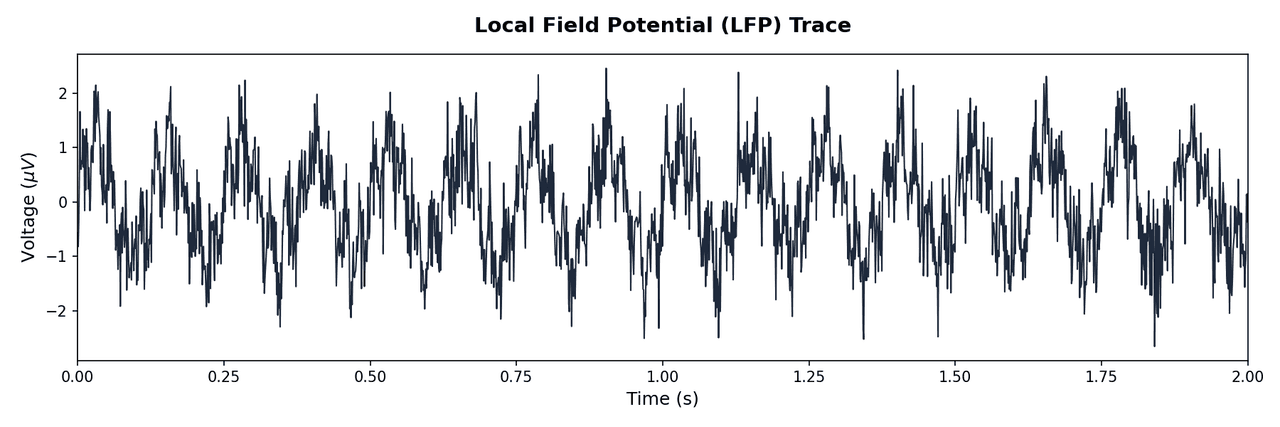
An LFP trace plots the continuous sub-threshold voltage signal recorded from a microelectrode as a function of time, reflecting the summed synaptic activity of nearby neuronal populations.
Key points
- Neuroscientists examine LFP traces to identify oscillatory rhythms such as theta, gamma, and slow-wave activity.
- These signals provide insight into network-level coordination and brain states that spike data alone cannot reveal.
Create a LFP Trace with your data using AI — no coding required.
Further reading
Complete Guide to Scientific Data Visualization
Chart selection, figure design, and publication-ready workflows for scientific teams.
Read the guideExample Visualization
Create This Chart Now
Generate publication-ready lfp traces with AI in seconds. No coding required – just describe your data and let AI do the work.
View example prompt
"Create a multi-channel LFP trace plot from my electrophysiology data. Stack each channel vertically with a fixed offset, colour-code channels, mark stimulus onset with a vertical dashed line, and apply publication-quality journal styling with labelled amplitude scale bar."
How to create this chart with your data
Upload Data
Upload your Excel or CSV file. Data used to generate charts is sent to Plotivy's server for processing.
AI Generation
Our AI analyzes your data and generates the LFP Trace code automatically.
Customize & Export
Tweak the design with natural language, then export as high-res PNG, SVG or PDF.
Newsletter
Get one weekly tip for better lfp traces
Join researchers receiving concise Python plotting techniques to improve chart clarity and reduce revision cycles.
Python Code Example
import numpy as np
import matplotlib.pyplot as plt

t = np.linspace(0, 2, 2000)
signal = np.sin(2 * np.pi * 8 * t) + 0.5 * np.sin(2 * np.pi * 40 * t) + np.random.normal(0, 0.5, len(t))

plt.figure(figsize=(12, 4))
plt.plot(t, signal, color='#1e293b', linewidth=1)
plt.title('Local Field Potential (LFP) Trace', fontsize=14, fontweight='bold', pad=15)
plt.xlabel('Time (s)', fontsize=12)
plt.ylabel('Voltage ($\mu V$)', fontsize=12)
plt.xlim(0, 2)
plt.tight_layout()
plt.savefig('plotivy-lfp-trace.png', dpi=150)
print("LFP trace generated successfully.")
Opens the Analyze page with this code pre-loaded and ready to execute
Console Output
LFP trace generated successfully.
Common Use Cases
- 1Identifying theta and gamma oscillations during spatial navigation tasks
- 2Detecting sharp-wave ripples in hippocampal sleep recordings
- 3Comparing oscillatory power before and after drug administration
- 4Monitoring depth profiles of slow-wave activity across cortical layers
Pro Tips
Apply a bandpass filter appropriate to the frequency band of interest before plotting
Stack multiple channels with a consistent vertical offset rather than overlapping them
Use a physical scale bar (e.g. 100 µV / 100 ms) instead of axis tick marks for publication
Mark experimental events with vertical lines or shaded rectangles aligned to the time axis
Frequently asked questions
When should you use an LFP trace?
An LFP trace plots the continuous sub-threshold voltage signal recorded from a microelectrode as a function of time, reflecting the summed synaptic activity of nearby neuronal populations. Neuroscientists examine LFP traces to identify oscillatory rhythms such as theta, gamma, and slow-wave activity. Common applications include identifying theta and gamma oscillations during spatial navigation tasks, detecting sharp-wave ripples in hippocampal sleep recordings, and comparing oscillatory power before and after drug administration.
Which Python libraries can create an LFP trace?
An LFP trace can be built in Python with matplotlib and numpy — matplotlib for precise control over axes, annotations, and journal styling and numpy. In Plotivy you describe the figure and it writes the matplotlib code for you.
Can I make an LFP trace without writing Python code?
Yes. Describe the LFP trace you need in plain language and upload your dataset — Plotivy's AI writes the Python code and renders a publication-ready figure. You still get the full, editable matplotlib source, so nothing is locked in a black box.
What are best practices for a clear LFP trace?
Apply a bandpass filter appropriate to the frequency band of interest before plotting. Stack multiple channels with a consistent vertical offset rather than overlapping them.
Library comparison for this chart
matplotlib
Best when you need full control over axis formatting, annotation placement, and journal-specific styling for lfp-trace.
numpy
Useful in specialized workflows that complement core Python plotting libraries for lfp-trace analysis tasks.
Scientific Chart Selection Cheat Sheet
Not sure whether to use a Violin Plot, Box Plot, or Ridge Plot? Download our single-page reference mapping the most-used scientific chart types, exactly when to use them, and the core Matplotlib/Seaborn functions.