Radial Column Chart
Chart overview
Radial column charts display data as columns radiating from a central point on a polar coordinate system.
Key points
- They are particularly effective for directional data like wind patterns or time-based metrics where the circular nature emphasizes periodicity.
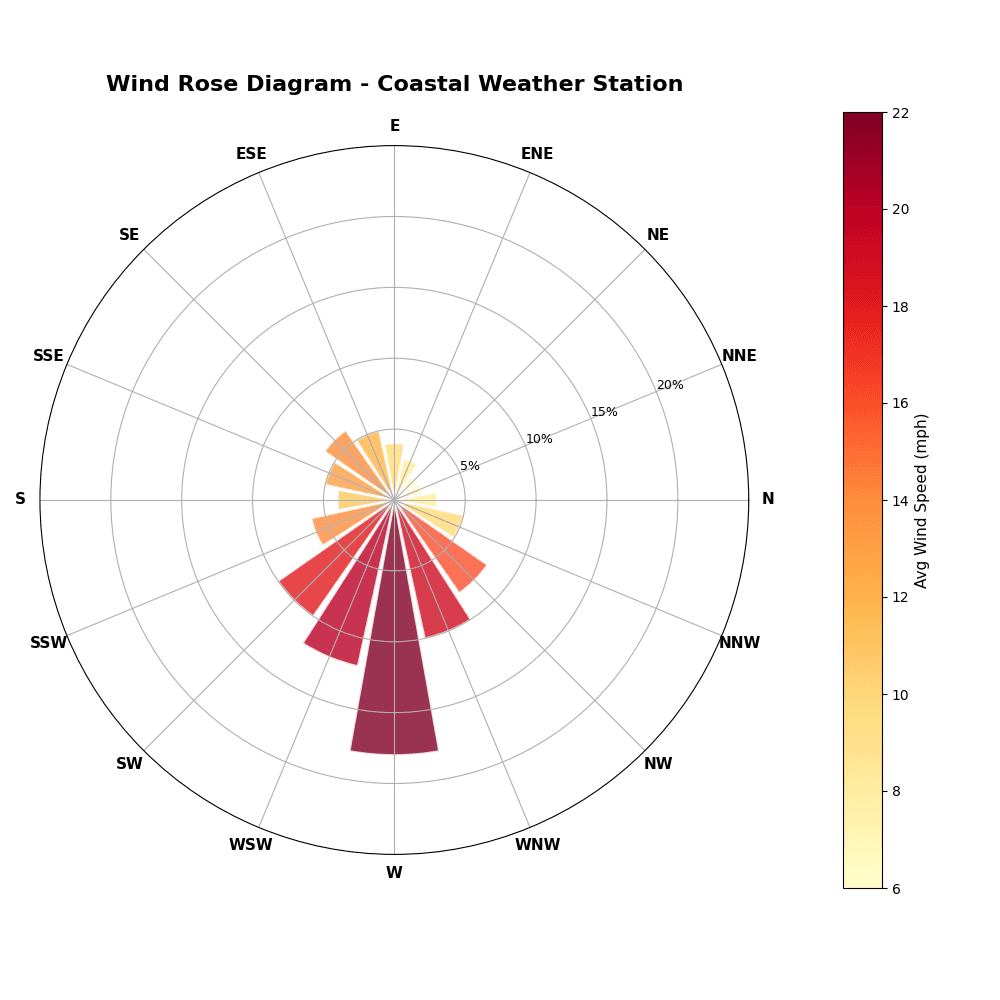
- The defining use case is genuinely angular data: a wind rose where each column's angle is a compass bearing and its length is frequency or speed, or a clock-style plot where angle is hour-of-day.
- When angle really encodes direction or cyclical time, the radial layout communicates something a linear bar chart cannot — that the axis wraps and that opposite directions are opposite.
Practical guidance
Outside that, be cautious: on a polar system the same data value produces a longer arc at the outer edge than near the center, so bars are not directly comparable by area, and reading exact lengths against curved gridlines is harder than against a straight y-axis. If your categories are not angular, a conventional bar chart is almost always clearer. When a radial column chart is warranted, keep angular divisions equal, add explicit directional or time labels (N/E/S/W, or 0-23h), consider stacking to show a second variable such as wind-speed bins within each direction, and include radial gridlines with labels so magnitude is recoverable. matplotlib's polar bar and the windrose library are the standard Python tools; the latter handles the speed-binned, color-stacked wind rose out of the box.
Create a Radial Column Chart with your data using AI — no coding required.
Further reading
How to Create a Bar Chart in Python
Matplotlib, seaborn, and plotly patterns for grouped bars, error bars, and publication-ready labels.
Read the guideExample Visualization
Create This Chart Now
Generate publication-ready radial column charts with AI in seconds. No coding required – just describe your data and let AI do the work.
View example prompt
"Create a radial column chart (wind rose) displaying 'Wind Speed Distribution' by direction for a coastal weather station. Generate realistic wind data for 16 compass directions (N, NNE, NE, ENE, E, ESE, SE, SSE, S, SSW, SW, WSW, W, WNW, NW, NNW). For each direction, show percentage of observations (total 100%) with prevailing winds from SW (15%), W (18%), NW (12%). Color columns by average wind speed in that direction using a blue-to-red gradient (5-25 mph range). Add concentric rings at 5%, 10%, 15%, 20% frequency. Include cardinal direction labels (N, E, S, W) and intermediate labels. Add legend for wind speed. Title: 'Annual Wind Rose - Coastal Station'."
How to create this chart with your data
Upload Data
Upload your Excel or CSV file. Data used to generate charts is sent to Plotivy's server for processing.
AI Generation
Our AI analyzes your data and generates the Radial Column Chart code automatically.
Customize & Export
Tweak the design with natural language, then export as high-res PNG, SVG or PDF.
Newsletter
Get one weekly tip for better radial column charts
Join researchers receiving concise Python plotting techniques to improve chart clarity and reduce revision cycles.
Python Code Example
# === IMPORTS ===
import pandas as pd
import numpy as np
import matplotlib.pyplot as plt

# === USER-EDITABLE PARAMETERS ===
title = "Wind Rose Diagram - Coastal Weather Station"
figsize = (10, 10)

# === EXAMPLE DATASET ===
# 16 compass directions
directions = ['N', 'NNE', 'NE', 'ENE', 'E', 'ESE', 'SE', 'SSE',
              'S', 'SSW', 'SW', 'WSW', 'W', 'WNW', 'NW', 'NNW']

# Frequency percentages (must sum to 100)
# Prevailing winds from SW, W, NW
frequencies = [3, 2, 2, 3, 4, 5, 6, 5,
               4, 6, 10, 12, 18, 10, 8, 5]  # Should be ~100%

# Average wind speeds (mph) in each direction
avg_speeds = [8, 7, 6, 8, 10, 12, 14, 13,
              11, 14, 18, 20, 22, 19, 16, 10]

# Print summary
print("=== Wind Rose Data Summary ===")
print(f"\nTotal frequency: {sum(frequencies)}%")
print(f"\nPrevailing wind directions:")
sorted_dirs = sorted(zip(directions, frequencies, avg_speeds), key=lambda x: x[1], reverse=True)
for dir_name, freq, speed in sorted_dirs[:5]:
    print(f"  {dir_name}: {freq}% at {speed} mph avg")
print(f"\nOverall average wind speed: {np.average(avg_speeds, weights=frequencies):.1f} mph")

# === CREATE WIND ROSE ===
fig, ax = plt.subplots(figsize=figsize, subplot_kw={'projection': 'polar'})

# Convert directions to angles (N = 0 degrees, clockwise)
theta = np.linspace(0, 2 * np.pi, len(directions), endpoint=False)
width = 2 * np.pi / len(directions) * 0.9

# Color by wind speed
norm = plt.Normalize(vmin=min(avg_speeds), vmax=max(avg_speeds))
colors = plt.cm.YlOrRd(norm(avg_speeds))

# Plot bars
bars = ax.bar(theta, frequencies, width=width, color=colors, edgecolor='white', linewidth=1.5, alpha=0.8)

# Add direction labels
ax.set_xticks(theta)
ax.set_xticklabels(directions, fontsize=11, fontweight='bold')

# Add concentric circles for frequency reference
ax.set_yticks([5, 10, 15, 20])
ax.set_yticklabels(['5%', '10%', '15%', '20%'], fontsize=9)
ax.set_ylim(0, 25)

# Title
ax.set_title(title, fontsize=16, fontweight='bold', pad=20)

# Colorbar for wind speed
sm = plt.cm.ScalarMappable(cmap=plt.cm.YlOrRd, norm=norm)
sm.set_array([])
cbar = plt.colorbar(sm, ax=ax, pad=0.1, shrink=0.8)
cbar.set_label('Avg Wind Speed (mph)', fontsize=11)

# Adjust layout
plt.tight_layout()
plt.show()
# END-OF-CODE
Opens the Analyze page with this code pre-loaded and ready to execute
Console Output
=== Wind Rose Data Summary ===

Total frequency: 103%

Prevailing wind directions:
  W: 18% at 22 mph avg
  WSW: 12% at 20 mph avg
  SW: 10% at 18 mph avg
  WNW: 10% at 19 mph avg
  NW: 8% at 16 mph avg

Overall average wind speed: 15.9 mph
Common Use Cases
- 1Wind rose diagrams
- 2Directional statistics
- 3Time-of-day analysis
- 4Compass-based data
Pro Tips
Use consistent angular divisions
Add directional labels (N, E, S, W)
Consider stacking for multiple variables
Frequently asked questions
When should you use a radial column chart?
Radial column charts display data as columns radiating from a central point on a polar coordinate system. They are particularly effective for directional data like wind patterns or time-based metrics where the circular nature emphasizes periodicity. Common applications include wind rose diagrams, directional statistics, and time-of-day analysis.
Which Python libraries can create a radial column chart?
A radial column chart can be built in Python with matplotlib — matplotlib for precise control over axes, annotations, and journal styling. In Plotivy you describe the figure and it writes the matplotlib code for you.
Can I make a radial column chart without writing Python code?
Yes. Describe the radial column chart you need in plain language and upload your dataset — Plotivy's AI writes the Python code and renders a publication-ready figure. You still get the full, editable matplotlib source, so nothing is locked in a black box.
What are best practices for a clear radial column chart?
Use consistent angular divisions. Add directional labels (N, E, S, W).
Library comparison for this chart
matplotlib
Best when you need full control over axis formatting, annotation placement, and journal-specific styling for radial-column-chart.
Scientific Chart Selection Cheat Sheet
Not sure whether to use a Violin Plot, Box Plot, or Ridge Plot? Download our single-page reference mapping the most-used scientific chart types, exactly when to use them, and the core Matplotlib/Seaborn functions.