XRD Pattern
Chart overview
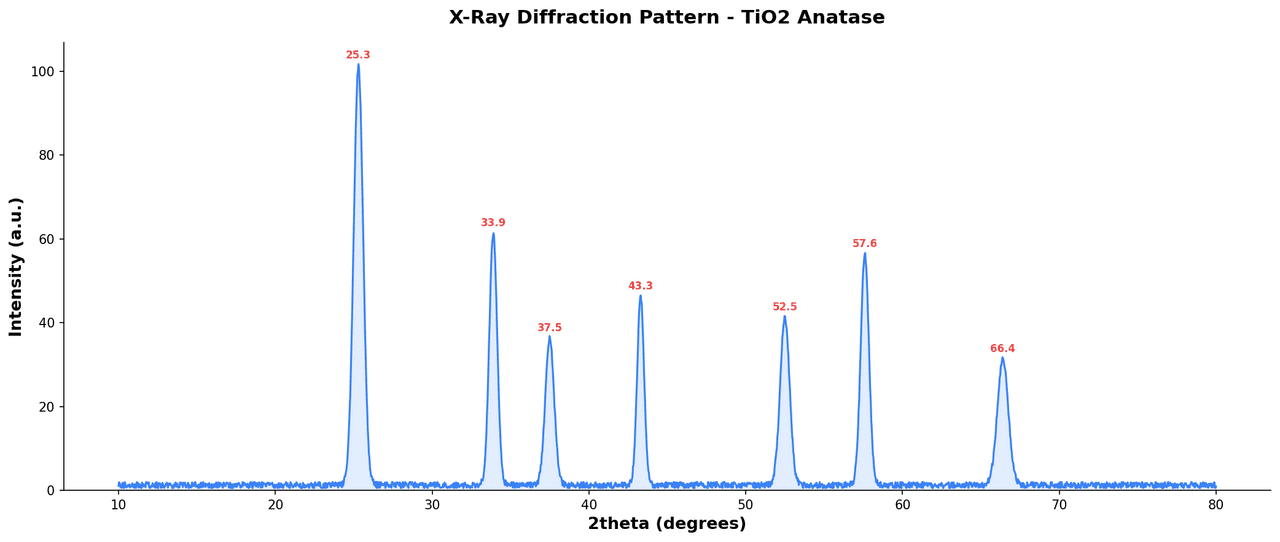
X-ray diffraction patterns are the definitive fingerprint of crystalline materials, providing lattice parameters, crystallite size via Scherrer broadening, phase composition, and preferred orientation.
Key points
- Each peak corresponds to a set of crystallographic planes satisfying Bragg's law, and its position, intensity, and width together encode structural information.
- XRD is ubiquitous in materials characterization, spanning thin films, nanoparticles, ceramics, alloys, and pharmaceuticals, making its clear visualization with Miller index labels essential for publication.
Create a XRD Pattern with your data using AI — no coding required.
Further reading
Complete Guide to Scientific Data Visualization
Chart selection, figure design, and publication-ready workflows for scientific teams.
Read the guideExample Visualization
Create This Chart Now
Generate publication-ready xrd patterns with AI in seconds. No coding required – just describe your data and let AI do the work.
View example prompt
"Create a publication-quality XRD pattern from my diffraction data. Plot intensity (counts or arbitrary units) on the y-axis versus 2-theta (degrees) on the x-axis. Label the major Bragg peaks with their Miller indices (hkl) as vertical annotations above each peak. Add reference vertical dashed lines at standard peak positions if reference data is available. Use a clean line plot style with tick marks on the x-axis every 5 or 10 degrees. Include axis labels, a legend for multiple samples if applicable, and a descriptive title. White background, professional styling."
How to create this chart with your data
Upload Data
Upload your Excel or CSV file. Data used to generate charts is sent to Plotivy's server for processing.
AI Generation
Our AI analyzes your data and generates the XRD Pattern code automatically.
Customize & Export
Tweak the design with natural language, then export as high-res PNG, SVG or PDF.
Newsletter
Get one weekly tip for better xrd patterns
Join researchers receiving concise Python plotting techniques to improve chart clarity and reduce revision cycles.
Python Code Example
Console Output
Figure saved: plotivy-xrd-pattern.png
Common Use Cases
- 1Phase identification and quantitative Rietveld refinement of polycrystalline samples
- 2Crystallite size determination via Scherrer equation from peak broadening
- 3Residual stress analysis from peak shift in thin films and coatings
- 4Monitoring solid-state reaction progress and phase transformation kinetics
Pro Tips
Normalize or offset multiple patterns vertically for easy comparison on the same axes
Annotate peaks with Miller indices at a consistent height above the peak maximum
Use a logarithmic y-axis to reveal weak peaks alongside strong dominant reflections
Shade the background contribution (amorphous hump) in gray to distinguish from crystalline peaks
Frequently asked questions
When should you use an XRD pattern?
X-ray diffraction patterns are the definitive fingerprint of crystalline materials, providing lattice parameters, crystallite size via Scherrer broadening, phase composition, and preferred orientation. Each peak corresponds to a set of crystallographic planes satisfying Bragg's law, and its position, intensity, and width together encode structural information. Common applications include phase identification and quantitative Rietveld refinement of polycrystalline samples, crystallite size determination via Scherrer equation from peak broadening, and residual stress analysis from peak shift in thin films and coatings.
Which Python libraries can create an XRD pattern?
An XRD pattern can be built in Python with matplotlib and numpy — matplotlib for precise control over axes, annotations, and journal styling and numpy. In Plotivy you describe the figure and it writes the matplotlib code for you.
Can I make an XRD pattern without writing Python code?
Yes. Describe the XRD pattern you need in plain language and upload your dataset — Plotivy's AI writes the Python code and renders a publication-ready figure. You still get the full, editable matplotlib source, so nothing is locked in a black box.
What are best practices for a clear XRD pattern?
Normalize or offset multiple patterns vertically for easy comparison on the same axes. Annotate peaks with Miller indices at a consistent height above the peak maximum.
Library comparison for this chart
matplotlib
Best when you need full control over axis formatting, annotation placement, and journal-specific styling for xrd-pattern.
numpy
Useful in specialized workflows that complement core Python plotting libraries for xrd-pattern analysis tasks.
Scientific Chart Selection Cheat Sheet
Not sure whether to use a Violin Plot, Box Plot, or Ridge Plot? Download our single-page reference mapping the most-used scientific chart types, exactly when to use them, and the core Matplotlib/Seaborn functions.