Growth Curve
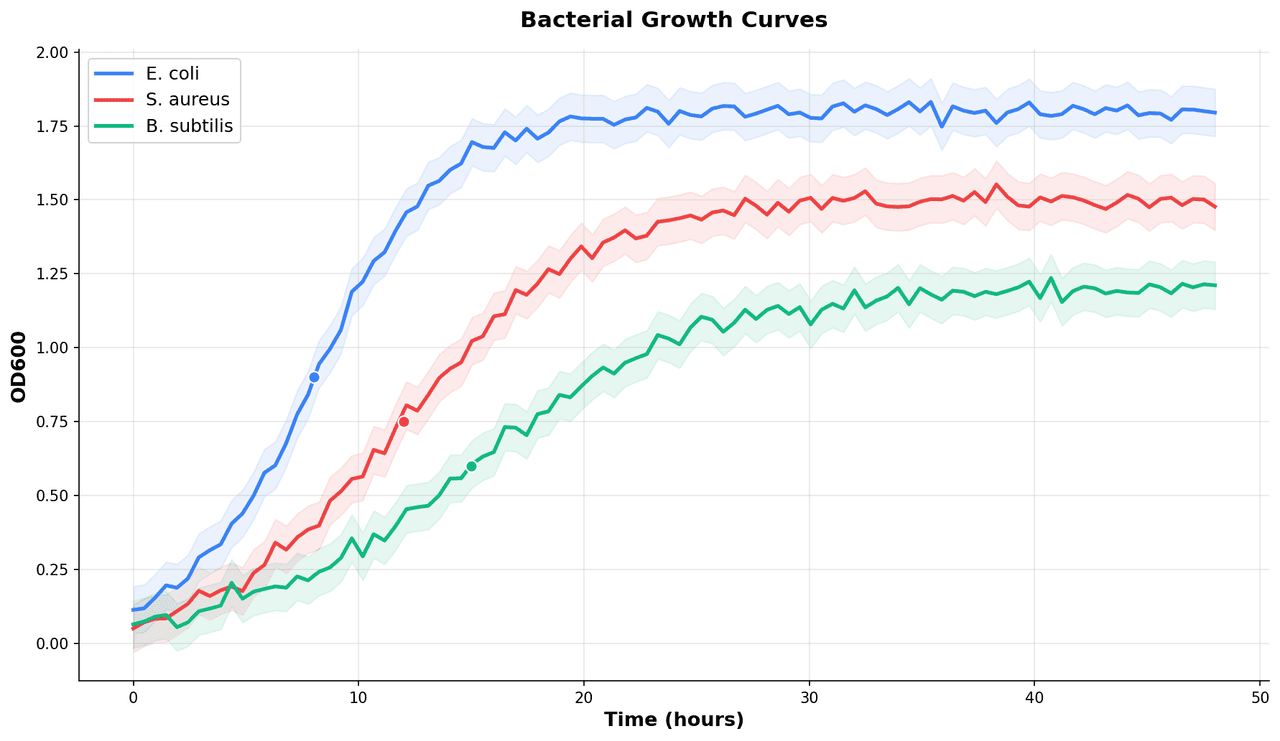
Chart overview
Growth curves are fundamental to microbiology, cell biology, and bioprocess engineering.
Key points
- An OD600 absorbance measurement taken at regular intervals traces three canonical phases: the lag phase where cells adapt to the medium, the exponential (log) phase where cells divide at maximum rate, and the stationary phase where nutrient depletion or waste accumulation limits growth.
- A fourth death phase is sometimes included.
- Fitting the Gompertz or logistic model to the data allows extraction of key parameters: maximum specific growth rate (mu_max), lag time (lambda), and carrying capacity (K).
Practical guidance
These parameters are essential for comparing strains, evaluating antibiotic effects on growth inhibition, or optimizing fermentation conditions. Python's scipy. optimize. curve_fit makes non-linear least-squares fitting straightforward, and error bars from replicate measurements communicate biological variability.
Create a Growth Curve with your data using AI — no coding required.
Further reading
Complete Guide to Scientific Data Visualization
Chart selection, figure design, and publication-ready workflows for scientific teams.
Read the guideExample Visualization
Create This Chart Now
Generate publication-ready growth curves with AI in seconds. No coding required – just describe your data and let AI do the work.
View example prompt
"Create a bacterial growth curve from my OD600 time-series data. Plot mean OD600 with standard deviation error bars for each condition. Fit a logistic growth model to each curve using scipy and overlay the fitted lines. Annotate the calculated doubling time and maximum growth rate on the plot. Use a log scale on the y-axis. Format for publication in a microbiology journal at 300 DPI."
How to create this chart with your data
Upload Data
Upload your Excel or CSV file. Data used to generate charts is sent to Plotivy's server for processing.
AI Generation
Our AI analyzes your data and generates the Growth Curve code automatically.
Customize & Export
Tweak the design with natural language, then export as high-res PNG, SVG or PDF.
Newsletter
Get one weekly tip for better growth curves
Join researchers receiving concise Python plotting techniques to improve chart clarity and reduce revision cycles.
Python Code Example
Console Output
Figure saved: plotivy-growth-curve.png
Common Use Cases
- 1Characterizing bacterial growth kinetics in response to nutrients, temperature, or pH changes
- 2Comparing antibiotic sensitivity by monitoring growth inhibition curves (MIC assays)
- 3Cell proliferation assays in cancer biology using WST-1 or CellTiter-Glo reagents
- 4Bioprocess optimization: monitoring biomass in fed-batch fermentation runs
Pro Tips
Plot on a semi-log y-axis to linearize the exponential phase and make doubling time visually apparent
Include at least three biological replicates and show individual data points alongside mean lines
Normalize all curves to the same starting OD to enable fair cross-condition comparisons
Report model fit quality (R-squared or residual sum of squares) alongside extracted parameters
Frequently asked questions
When should you use a growth curve?
Growth curves are fundamental to microbiology, cell biology, and bioprocess engineering. An OD600 absorbance measurement taken at regular intervals traces three canonical phases: the lag phase where cells adapt to the medium, the exponential (log) phase where cells divide at maximum rate, and the stationary phase where nutrient depletion or waste accumulation limits growth. Common applications include characterizing bacterial growth kinetics in response to nutrients, temperature, or pH changes, comparing antibiotic sensitivity by monitoring growth inhibition curves (MIC assays), and cell proliferation assays in cancer biology using WST-1 or CellTiter-Glo reagents.
Which Python libraries can create a growth curve?
A growth curve can be built in Python with matplotlib, numpy, scipy, and pandas — matplotlib for precise control over axes, annotations, and journal styling, numpy, scipy, and pandas for quick plots straight from a DataFrame. In Plotivy you describe the figure and it writes the matplotlib code for you.
Can I make a growth curve without writing Python code?
Yes. Describe the growth curve you need in plain language and upload your dataset — Plotivy's AI writes the Python code and renders a publication-ready figure. You still get the full, editable matplotlib source, so nothing is locked in a black box.
What are best practices for a clear growth curve?
Plot on a semi-log y-axis to linearize the exponential phase and make doubling time visually apparent. Include at least three biological replicates and show individual data points alongside mean lines.
Library comparison for this chart
matplotlib
Best when you need full control over axis formatting, annotation placement, and journal-specific styling for growth-curve.
numpy
Useful in specialized workflows that complement core Python plotting libraries for growth-curve analysis tasks.
scipy
Useful in specialized workflows that complement core Python plotting libraries for growth-curve analysis tasks.
pandas
Good for quick exploratory drafts directly from DataFrame operations before polishing in matplotlib or plotly.
Scientific Chart Selection Cheat Sheet
Not sure whether to use a Violin Plot, Box Plot, or Ridge Plot? Download our single-page reference mapping the most-used scientific chart types, exactly when to use them, and the core Matplotlib/Seaborn functions.