How to Add a Secondary Y-Axis in ggplot2 (sec_axis)
Secondary y-axes can be controversial in data visualization because they can obscure scaling ratios. However, displaying dual variables over time (such as Temperature and Precipitation) is a common requirement. In ggplot2, secondary axes must be defined as a direct mathematical transformation of the primary axis.
In This Tutorial
0.Live Code: Dual Axis Plot
1.The Philosophy of Dual Axes
2.Defining a Secondary Scale (sec_axis)
3.Correct Scaling Transformations
4.Alternative Designs (Panel Facets)
0. Live Code: Dual Axis Plot
Process tracking. Customize parameters using Python below, or upload your data to run R directly.
1. The Philosophy of Dual Axes in ggplot2
Unlike matplotlib (which allows arbitrary scale overlay using `twinx()`), ggplot2 strictly forces the secondary axis to be a transformation of the primary axis (e.g. multiplying by a constant scale factor). This maintains the underlying coordinate layout integrity.
2. Defining a Secondary Scale (sec_axis)
Try it
Try it now: turn this method into your next figure
Apply the same approach to your own dataset and generate clean, publication-ready code and plots in minutes.
Open in Plotivy Analyze →Newsletter
Get a weekly Python plotting tip
One concise tip each week for cleaner, faster scientific figures. Built for researchers who publish.
Map the primary variable. Then define `sec.axis` inside the primary scale function, indicating the mathematical formula:
R / ggplot2
# Secondary axis mapping (e.g. Celsius to Fahrenheit: * 1.8 + 32)
ggplot(df, aes(x = time, y = temp_celsius)) +
  geom_line() +
  scale_y_continuous(
    name = "Celsius (°C)",
    sec.axis = sec_axis(trans = ~ . * 1.8 + 32, name = "Fahrenheit (°F)")
  )
3. Correct Scaling Transformations
To plot two completely different units (e.g. Temperature 0–40 and Rain 0–200), transform the rain column values in the `geom` layer mapping, and apply the inverse scale transformation in `sec_axis`:
R / ggplot2
# Rain scale is 5x Temp scale. Shrink rain values to fit on temp axis.
ggplot(df, aes(x = day)) +
  geom_line(aes(y = temperature, color = "Temp")) +
  geom_col(aes(y = precipitation / 5, fill = "Rain"), alpha = 0.3) +
  scale_y_continuous(
    name = "Temperature (°C)",
    sec.axis = sec_axis(trans = ~ . * 5, name = "Precipitation (mm)")
  )
4. Alternative Designs: Panel Facets
If axes scaling represents completely unrelated entities, consider using `facet_wrap(..., scales = "free_y")` to stack plots vertically. This is often cleaner and avoids scaling confusion.
Chart gallery
Explore related formats
Review dual formats.
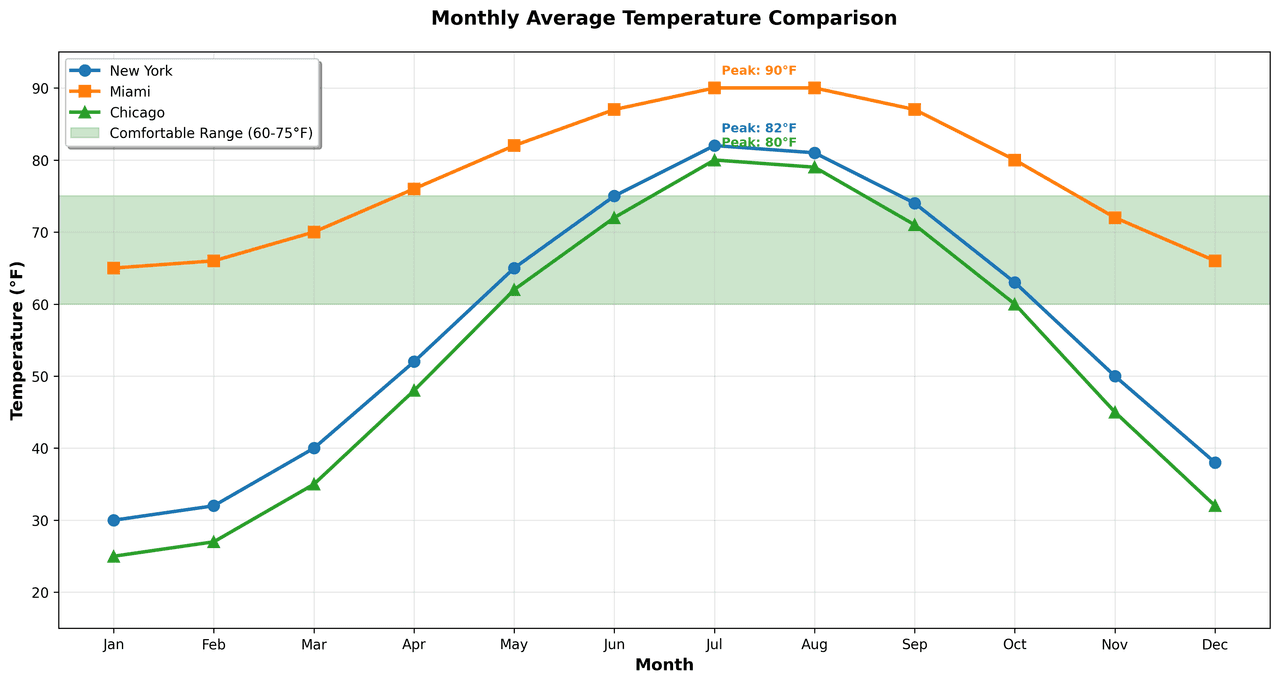
Line Graph
Create a line graph in Python to connect ordered data points, reveal time-series trends, and compare how multiple values change across a continuous scale.
Sample code / prompt
import matplotlib.pyplot as plt
import numpy as np

# Generate temperature data for 3 major US cities over 12 months
months = ['Jan', 'Feb', 'Mar', 'Apr', 'May', 'Jun', 'Jul', 'Aug', 'Sep', 'Oct', 'Nov', 'Dec']
nyc = [30, 32, 40, 52, 65, 75, 82, 81, 74, 63, 50, 38]
miami = [65, 66, 70, 76, 82, 87, 90, 90, 87, 80, 72, 66]
chicago = [25, 27, 35, 48, 62, 72, 80, 79, 71, 60, 45, 32]

# Create figure with enhanced styling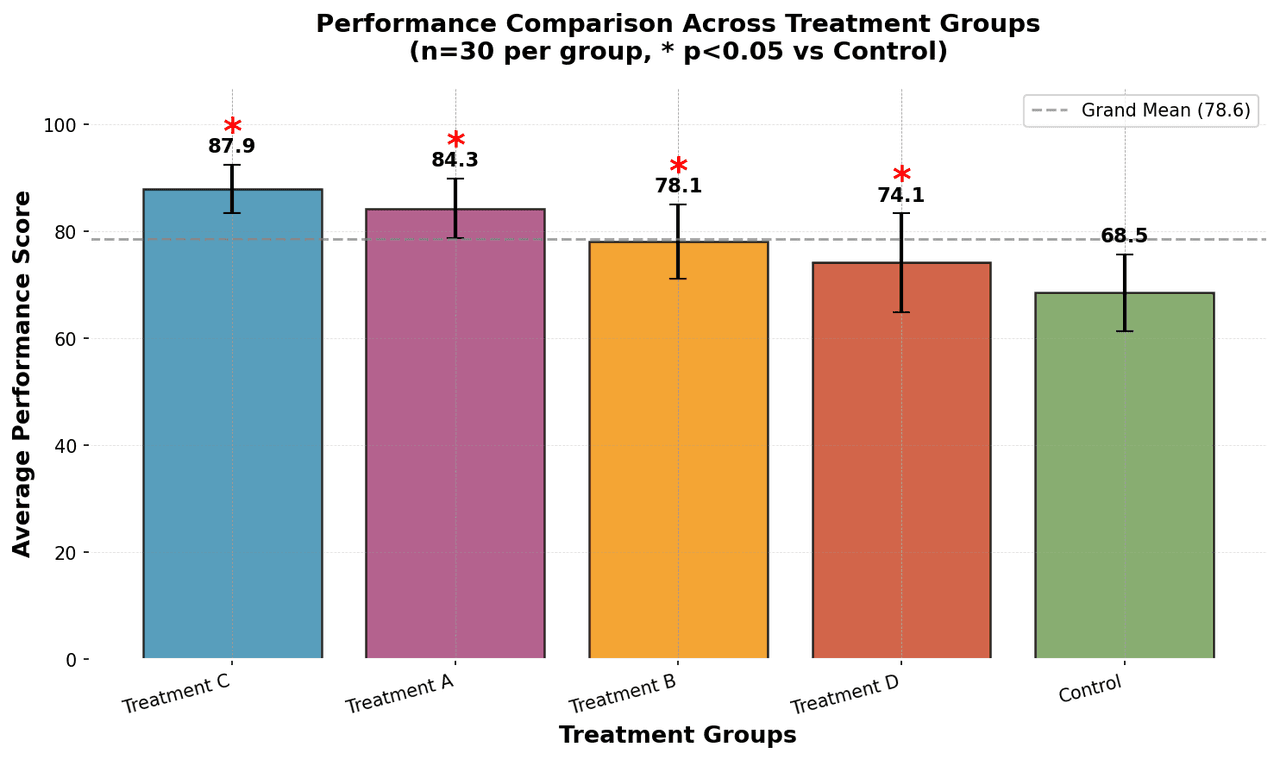
Bar Chart
Create a bar chart in Python to compare categorical values with proportional bars, error bars, clear labels, and grouped comparisons.
Sample code / prompt
import numpy as np
import pandas as pd
import matplotlib.pyplot as plt
import seaborn as sns
from scipy import stats

# Generate performance scores for 5 treatment groups
np.random.seed(42)
groups = ['Control', 'Treatment A', 'Treatment B', 'Treatment C', 'Treatment D']
n_samples = 30Build This Dual Axis Plot Online
Upload your data and describe the design. Plotivy writes the ggplot2 code and executes it instantly.
Technique guides scientists read next
scipy.signal.find_peaks guide
Tune prominence and width parameters for robust peak extraction.
Savitzky-Golay smoothing
Reduce noise while preserving peak shape and position.
PCA visualization workflow
Move from high-dimensional measurements to interpretable components.
ANOVA with post-hoc brackets
Add statistically correct pairwise significance annotations.
Found this helpful? Share it with your network.
Experimental Physicist & Photonics Researcher
Hands-on experience in silicon photonics, semiconductor fabrication (DRIE/ICP-RIE), optical simulation, and data-driven analysis. Built Plotivy to help researchers focus on discoveries instead of data struggles.
More about the authorVisualize your own data
Apply the techniques from this article to your own datasets. Upload CSV, Excel, or paste data directly.