Free Scientific Plotting Tools Comparison (2026): Best Options for Publication Figures
The landscape of scientific plotting has shifted dramatically in 2026. You no longer have to choose between the steep learning curve of code (Python/R) and the rigid limitations of spreadsheets.
A new generation of AI-first tools has emerged, bridging the gap: you get the reproducibility and power of code with the ease of a modern web interface.
What You'll Learn
0.Live Demo: Plotivy in Action
1.2026 Tools Comparison Matrix
2.Editor's Choice: Plotivy
3.Tool Deep-Dives
4.FAQ
0. Live Demo: Plotivy in Action
This figure was generated from a single prompt: "Compare sensor readings across 4 stations with error bars and highlight the outlier station." Modify the code and re-run it.
1. 2026 Scientific Tools Matrix
Head-to-Head Comparison
Updated Jan 2026| Tool | Learning Curve | Reproducibility | AI Assisted? | Best For |
|---|---|---|---|---|
| Plotivy | Low (Instant) | High (Code Gen) | Yes | Publication Figures |
| Matplotlib | Steep (Coding) | Very High | No | Custom Code |
| ggplot2 | Steep (Code/R) | Very High | No | Statisticians |
| RAWGraphs | Low | Low | No | Quick SVG |
| Excel | Medium | Low | Limited | Basic Tables |
Try it
Try it now: review your figure before submission
Upload your current plot and get an AI critique with concrete fixes for clarity, typography, color, and journal readiness.
Open AI Figure Reviewer →Newsletter
Get a weekly Python plotting tip
One concise tip each week for cleaner, faster scientific figures. Built for researchers who publish.
2. Editor's Choice: Plotivy
Best Overall for Modern Research
Plotivy redefines the workflow. Instead of writing 100 lines of Matplotlib boilerplate, you describe your plot or upload your dataset. The AI writes the Python code, generates the figure, and hands you both.
100% Reproducible
You get the Python code for every plot.
Vector Export
SVG/PDF ready for Nature & Science.
Instant Analysis
Stats & plots in seconds.
Gallery Access
50+ Templates included.
3. Tool Deep-Dives
Best for Coders: Matplotlib
The grand-daddy of Python plotting. Infinite control if you have the time to master it.
- Standard for scientific papers.
- Extremely customizable API.
- Requires writing verbose code.
Best for R Users: ggplot2
Based on the grammar of graphics, elegant and powerful for statistical exploration.
- Beautiful default themes.
- Great for faceting complex data.
- Hard to customize outside 'the grammar'.
Best No-Code: Datawrapper
Excellent for journalism and simple charts, but lacks specific scientific plot types.
- Very polished design defaults.
- Limited scientific feature set.
Best Interactive: Plotly
If you need 3D rotation or zoomable web charts, Plotly is the king.
- Interactive HTML export.
- Files can get very heavy.
4. Frequently Asked Questions
Can I use Plotivy for free?
Yes, Plotivy offers a generous free tier that includes scientific plotting features, AI generation, and standard exports.
Are the figures really 'publication ready'?
Absolutely. We support high-DPI raster export and fully scalable vector (SVG/PDF) export, required by Nature, Science, and Cell.
Do I need to know Python?
No. Plotivy writes the Python code for you. However, since the code is provided, it is a great way to learn Python if you want to.
Chart gallery
Browse by chart type
Explore the full gallery of scientific chart templates.
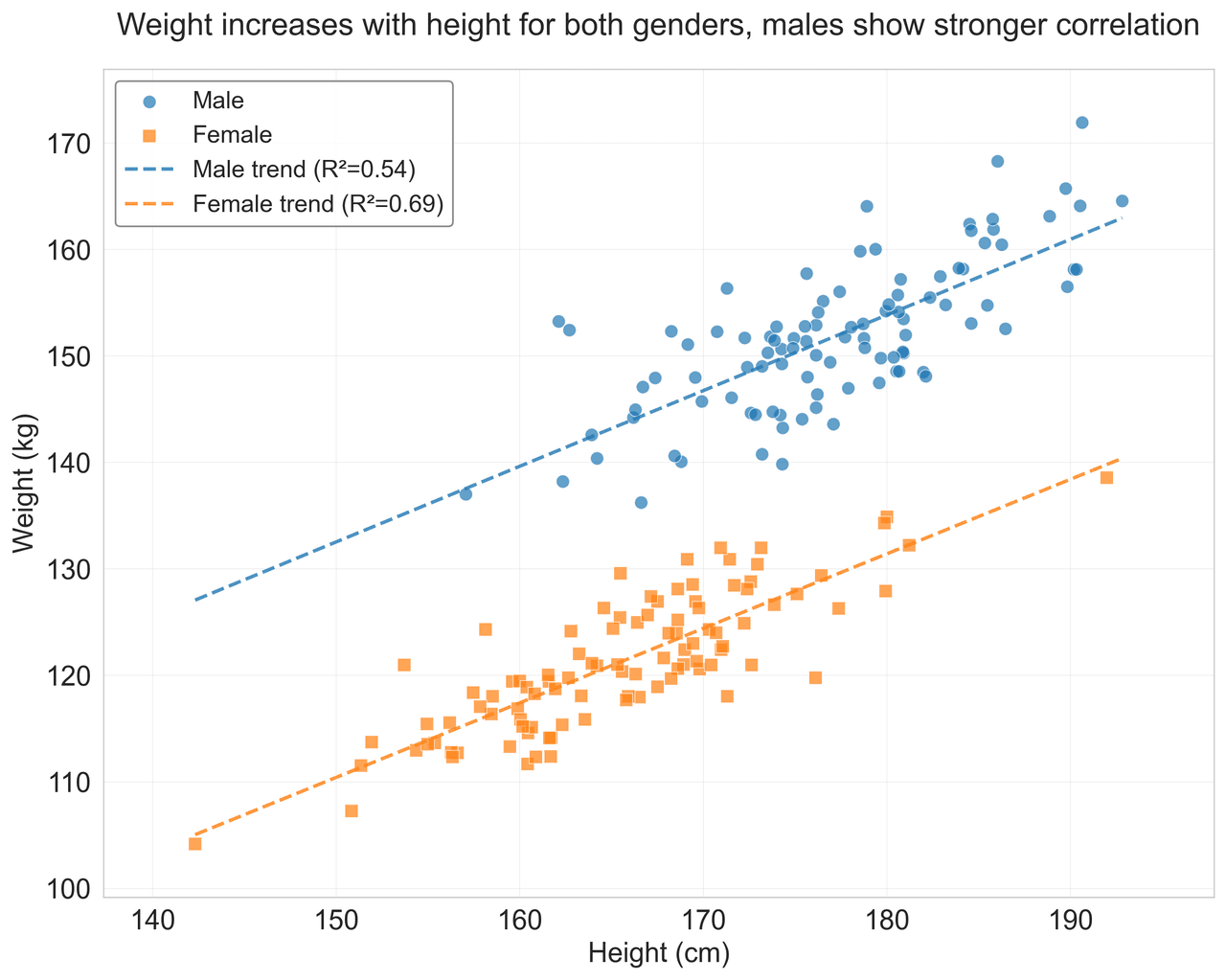
Scatterplot
A scatter plot displays two quantitative variables as points, helping you examine relationships, clusters, outliers, and regression trends.
Sample code / prompt
import matplotlib.pyplot as plt
import numpy as np
from scipy import stats
import pandas as pd

# Generate sample data
np.random.seed(42)
n_samples = 200
height = np.random.normal(170, 8, n_samples)
weight = height * 0.6 + np.random.normal(0, 8, n_samples) - 50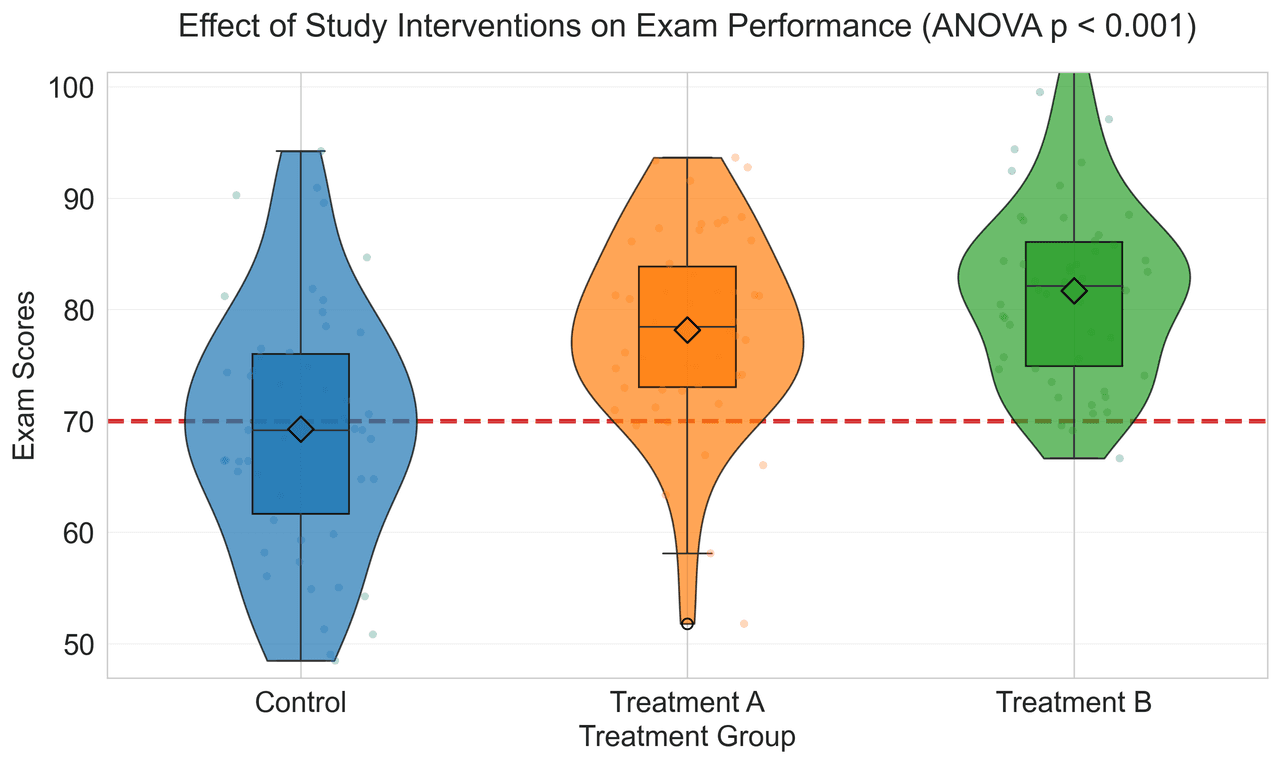
Violin Plot
Combines box plots with kernel density to show distribution shape across groups.
Sample code / prompt
import matplotlib.pyplot as plt
import seaborn as sns
import pandas as pd
import numpy as np
from scipy.stats import f_oneway

# Generate exam score data for 3 groups
np.random.seed(42)
control = np.random.normal(72, 12, 50)
treatment_a = np.random.normal(78, 10, 50)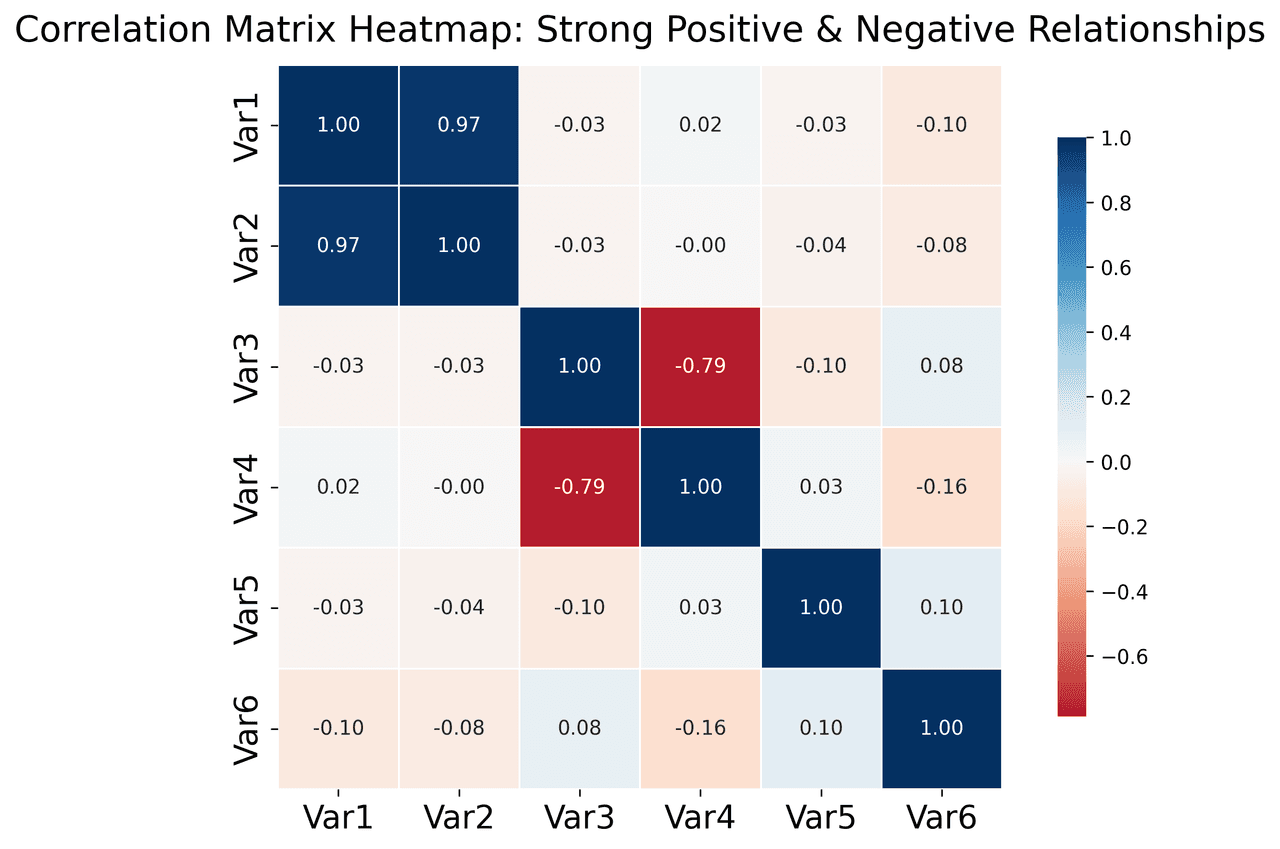
Heatmap
Represents data values as colors in a two-dimensional matrix format.
Sample code / prompt
import matplotlib.pyplot as plt
import seaborn as sns
import pandas as pd
import numpy as np

# Create correlation matrix for financial metrics
metrics = ['Revenue', 'Profit', 'Expenses', 'ROI', 'Customers', 'AOV', 'Marketing', 'Employees']
correlation_data = np.array([
    [1.00, 0.85, -0.45, 0.72, 0.88, 0.65, 0.72, 0.55],
[0.85, 1.00, -0.78, 0.92, 0.75, 0.58, 0.63, 0.48],.png&w=1280&q=70)
Box and Whisker Plot
Create a box plot in Python to compare distributions using quartiles, medians, whiskers, and outliers.
Sample code / prompt
import numpy as np
import pandas as pd
import matplotlib.pyplot as plt
import seaborn as sns
from scipy import stats

# Generate gene expression data for 4 genotypes
np.random.seed(42)
genotypes = ['WT', 'KO1', 'KO2', 'Mutant']
n_per_group = 20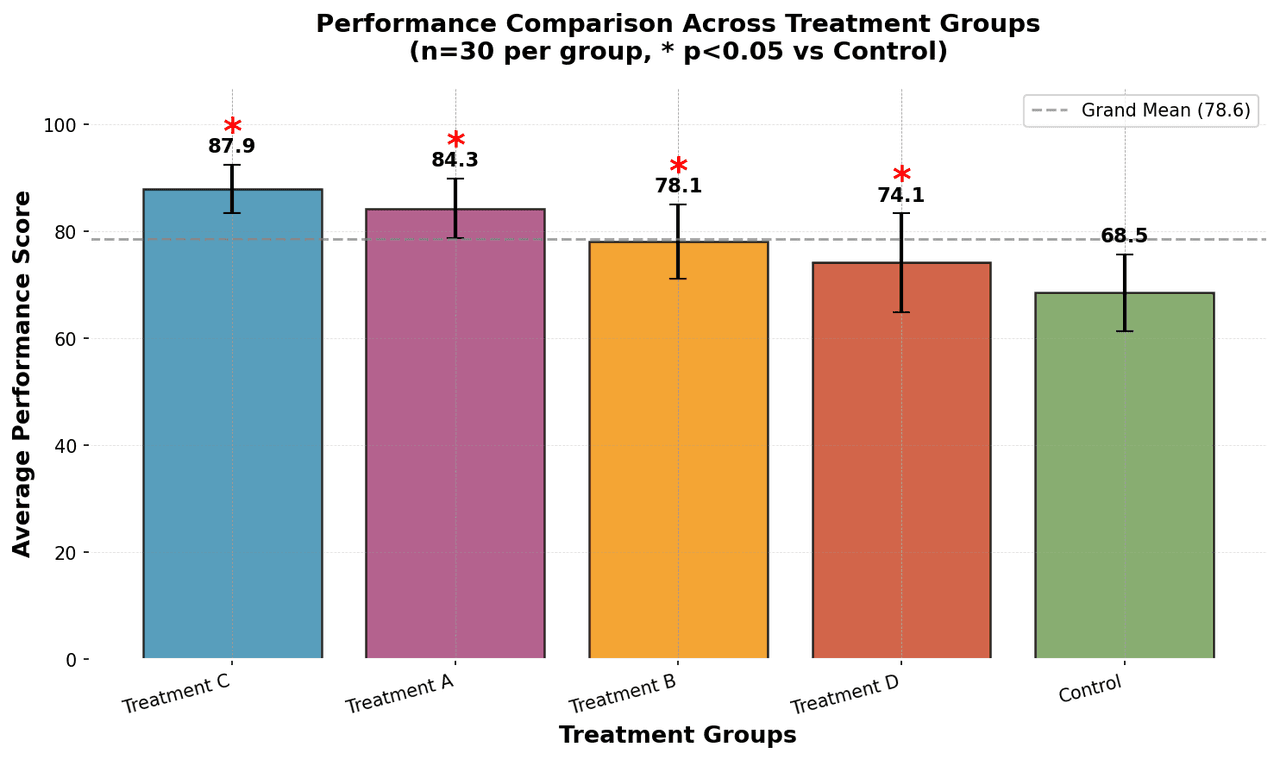
Bar Chart
Create a bar chart in Python to compare categorical values with proportional bars, error bars, clear labels, and grouped comparisons.
Sample code / prompt
import numpy as np
import pandas as pd
import matplotlib.pyplot as plt
import seaborn as sns
from scipy import stats

# Generate performance scores for 5 treatment groups
np.random.seed(42)
groups = ['Control', 'Treatment A', 'Treatment B', 'Treatment C', 'Treatment D']
n_samples = 30Stop wasting time formatting graphs
Compare scientific plotting workflows, generate editable code, and choose the tool that fits your research.
Related chart guides
Apply this tutorial directly in the chart gallery with ready-to-run prompts and examples.
Technique guides scientists read next
scipy.signal.find_peaks guide
Tune prominence and width parameters for robust peak extraction.
Savitzky-Golay smoothing
Reduce noise while preserving peak shape and position.
PCA visualization workflow
Move from high-dimensional measurements to interpretable components.
ANOVA with post-hoc brackets
Add statistically correct pairwise significance annotations.
Found this helpful? Share it with your network.
Experimental Physicist & Photonics Researcher
Hands-on experience in silicon photonics, semiconductor fabrication (DRIE/ICP-RIE), optical simulation, and data-driven analysis. Built Plotivy to help researchers focus on discoveries instead of data struggles.
More about the authorVisualize your own data
Apply the techniques from this article to your own datasets. Upload CSV, Excel, or paste data directly.